


Introduction
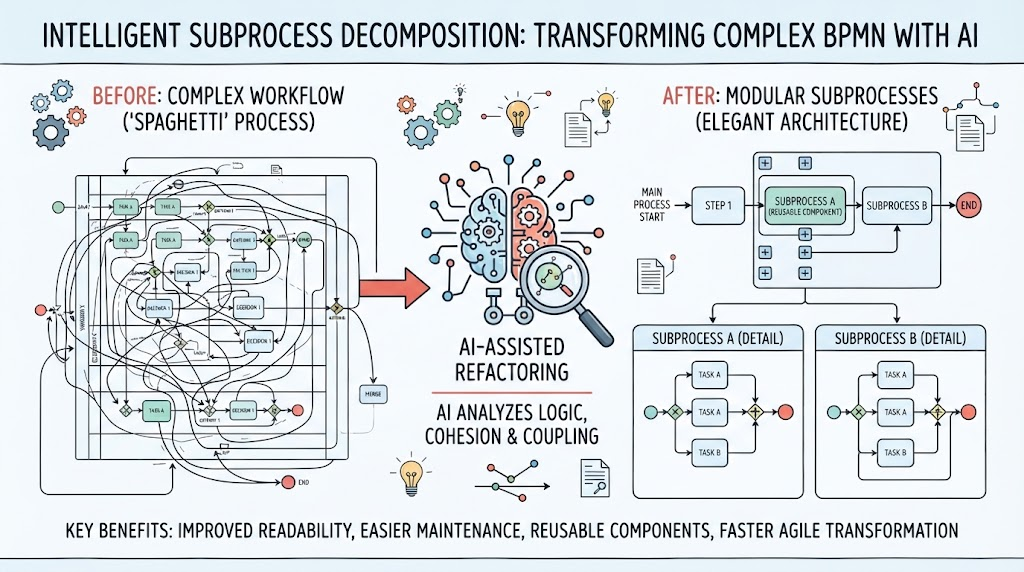
Business Process Model and Notation (BPMN) diagrams are powerful tools for visualizing workflows, but they often suffer from a common ailment: complexity. As processes grow, diagrams can quickly devolve into “spaghetti”—tangled webs of activities, gateways, and flows that are difficult to read, maintain, or translate into actionable requirements. This complexity hinders collaboration between business stakeholders and technical teams, slowing down agile transformation efforts.
The solution lies in Intelligent Subprocess Decomposition. By strategically breaking down high-level processes into granular, cohesive subprocesses, we can create cleaner, more modular architectures. But how do we determine the optimal boundaries? Enter Artificial Intelligence. Modern tooling like Visual Paradigm leverages AI to analyze process logic, suggesting decomposition boundaries based on principles of cohesion and coupling. This guide explores how to harness AI-assisted refactoring to transform chaotic diagrams into elegant, reusable BPMN structures.
Key Concepts: Intelligent Subprocess Decomposition
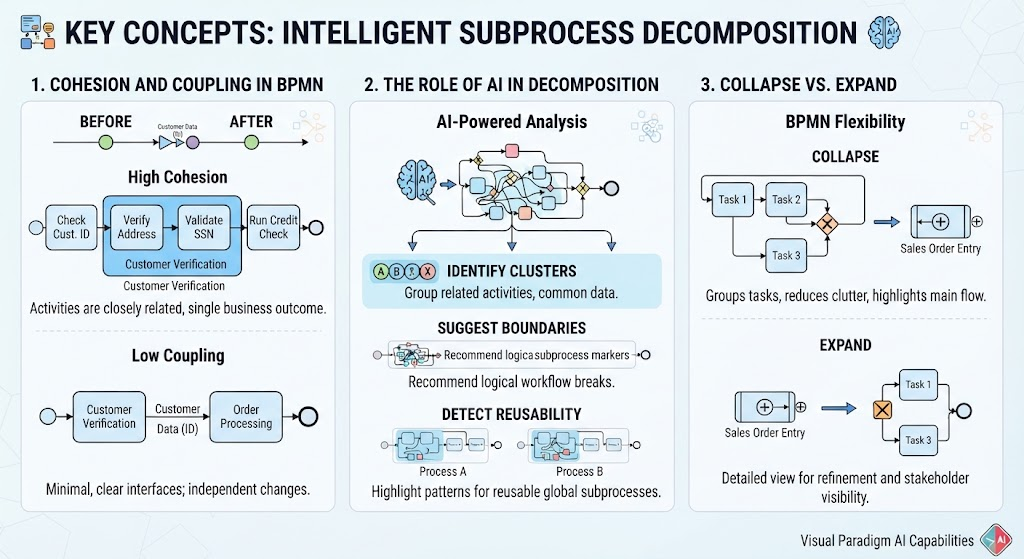
1. Cohesion and Coupling in BPMN
Just as in software architecture, good process design relies on high cohesion and low coupling.
-
High Cohesion: Activities within a subprocess should be closely related and contribute to a single, well-defined business outcome. For example, all steps related to “Customer Verification” should reside in one subprocess.
-
Low Coupling: Subprocesses should interact through clear, minimal interfaces (data objects or messages). A change in one subprocess should not necessitate widespread changes in others.
2. The Role of AI in Decomposition
AI algorithms can analyze the semantic relationships between activities, data flows, and decision points. Visual Paradigm’s AI capabilities can:
-
Identify Clusters: Group activities that frequently occur together or share common data inputs.
-
Suggest Boundaries: Recommend where to insert subprocess markers based on logical breaks in the workflow.
-
Detect Reusability: Highlight patterns that appear across multiple processes, suggesting they be collapsed into reusable global subprocesses.
3. Collapse vs. Expand
-
Collapse: When a sequence of tasks forms a self-contained unit with a clear start and end, it should be collapsed into a subprocess. This reduces visual clutter and highlights the main flow.
-
Expand: If a subprocess becomes too complex or if stakeholders need visibility into specific details, it can be expanded back into its constituent tasks for refinement.
Tooling: Visual Paradigm
Visual Paradigm offers robust features for both creating BPMN diagrams and managing the transition to agile requirements. Its AI capabilities can even help generate initial diagrams from text descriptions, speeding up the initial analysis phase.
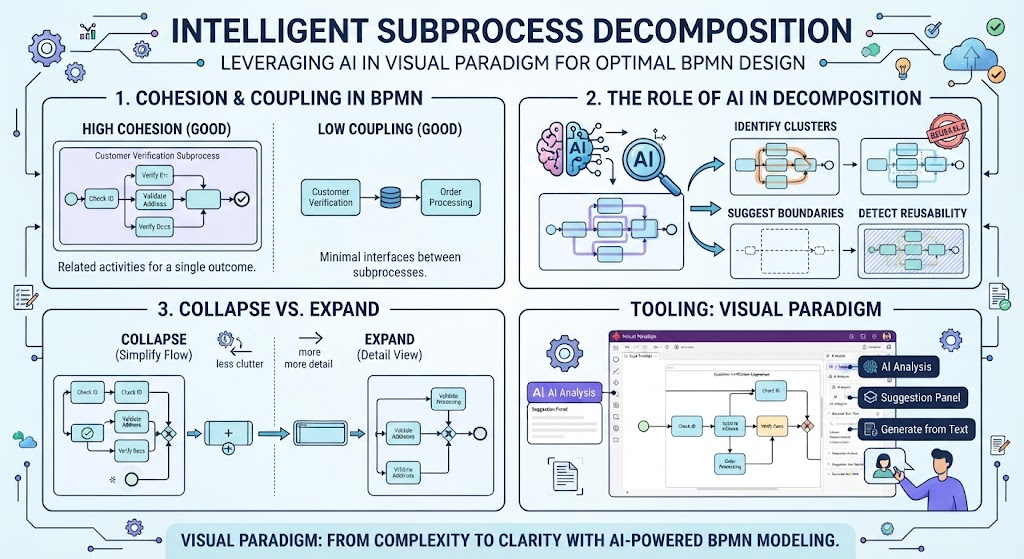
(The Figure: showcases the Visual Paradigm interface for creating and managing BPMN diagrams)
How Visual Paradigm’s AI Assists in Refactoring
-
Natural Language to Diagram: Start by describing your process in plain English. The AI BPMN Generator creates an initial draft, providing a baseline for refinement.
-
Interactive Refinement: Use the AI Chatbot to ask questions like, “Which parts of this process can be grouped?” or “Suggest a subprocess for the payment validation steps.”
-
Simulation and Validation: Before finalizing your decomposition, use Visual Paradigm’s simulation features to test the logic. Ensure that collapsing activities into subprocesses doesn’t introduce dead ends or logical errors.
Best Practices for Success
-
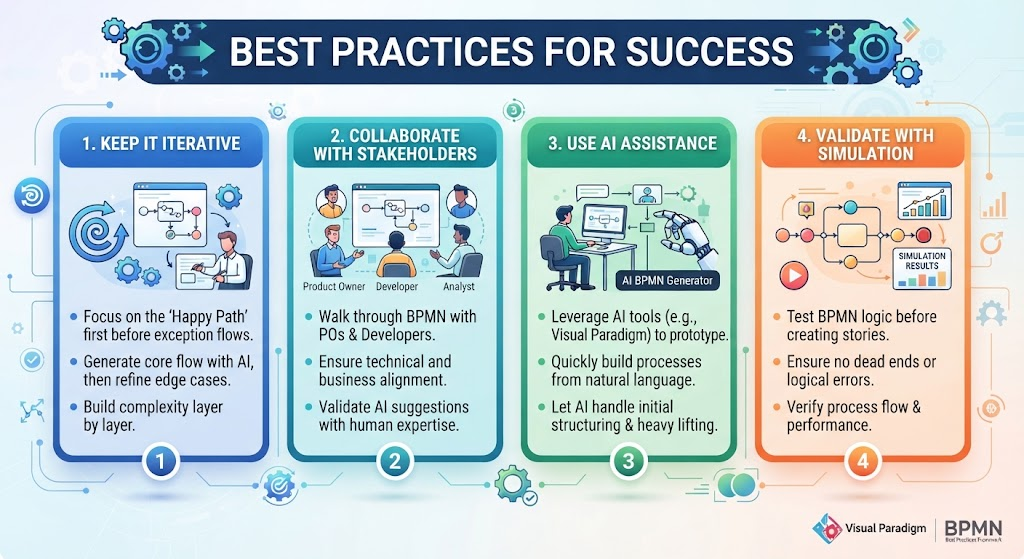
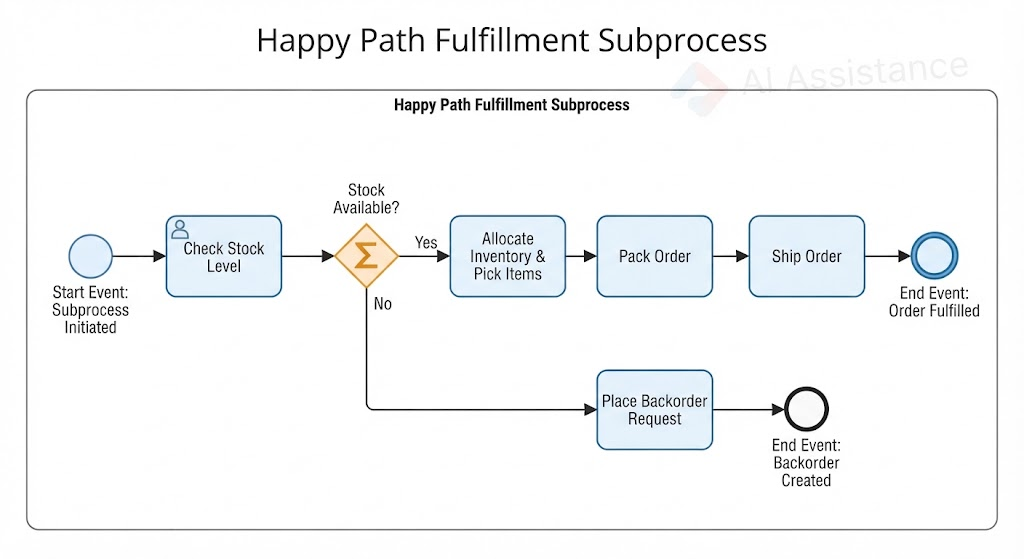
Keep it Iterative: Focus on the “Happy Path” first before writing stories for exception flows and error events. Use AI to generate the core flow, then manually refine edge cases.
-
Collaborate with Stakeholders: Walk through the BPMN diagram with Product Owners and developers while drafting the stories to ensure technical and business alignment. AI-generated suggestions should always be validated by human expertise.
-
Use AI Assistance: Leverage tools like Visual Paradigm’s AI BPMN Generator to quickly prototype processes from natural language descriptions, then refine them into detailed models. Let AI handle the heavy lifting of initial structuring.
-
Validate with Simulation: Use simulation features in tools like Visual Paradigm to test the logic of your BPMN diagram before converting it into stories, ensuring no dead ends or logical errors exist.
Examples: From Spaghetti to Structure
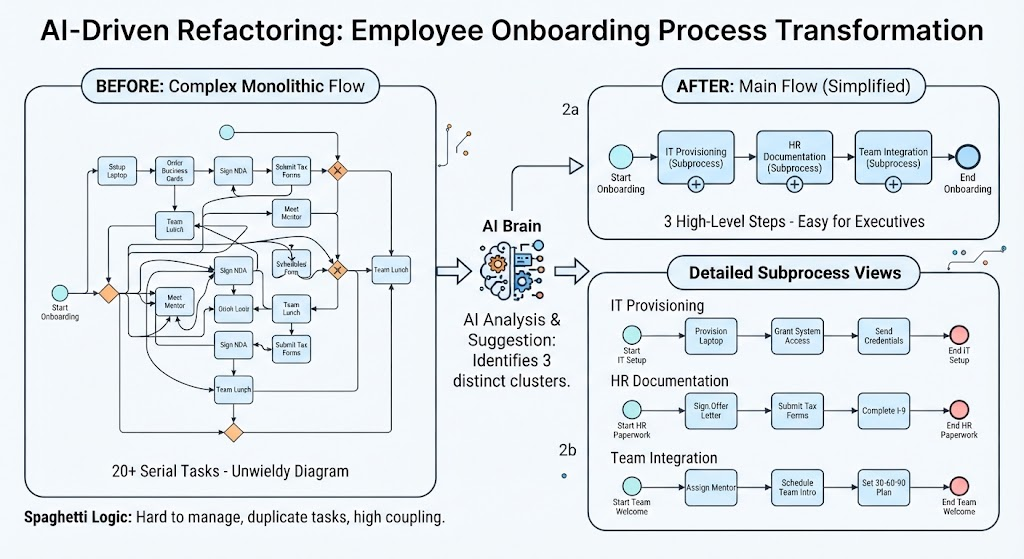
Example 1: Employee Onboarding
Before: A single lane containing 20+ tasks ranging from IT setup to HR paperwork, creating a long, unwieldy diagram.
AI Suggestion: The AI identifies three distinct clusters: “IT Provisioning,” “HR Documentation,” and “Team Integration.”
After: Three collapsed subprocesses, each with its own detailed diagram. The main flow shows only three high-level steps, making it easy for executives to grasp the overall timeline.
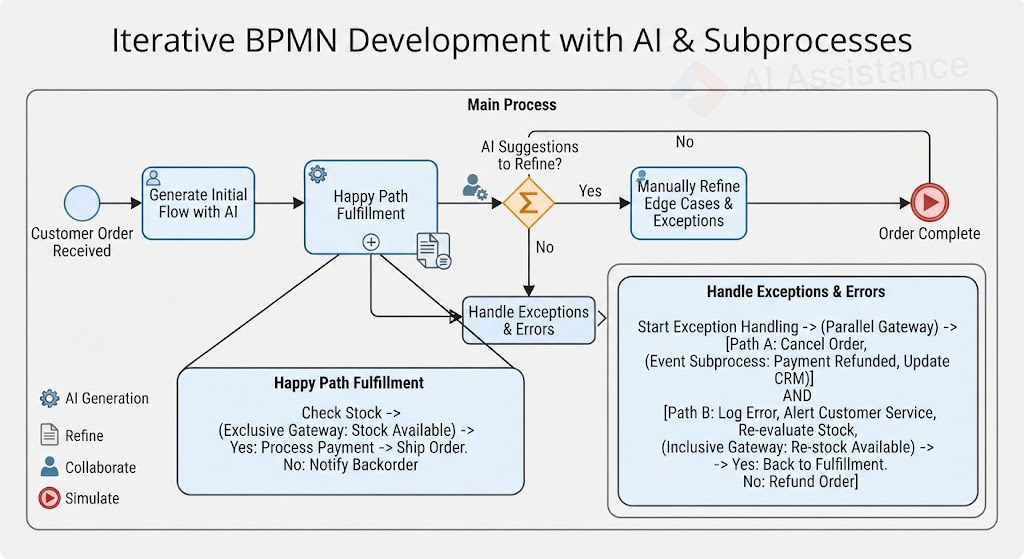
Happy Path Fullfillment BPMN subprocess
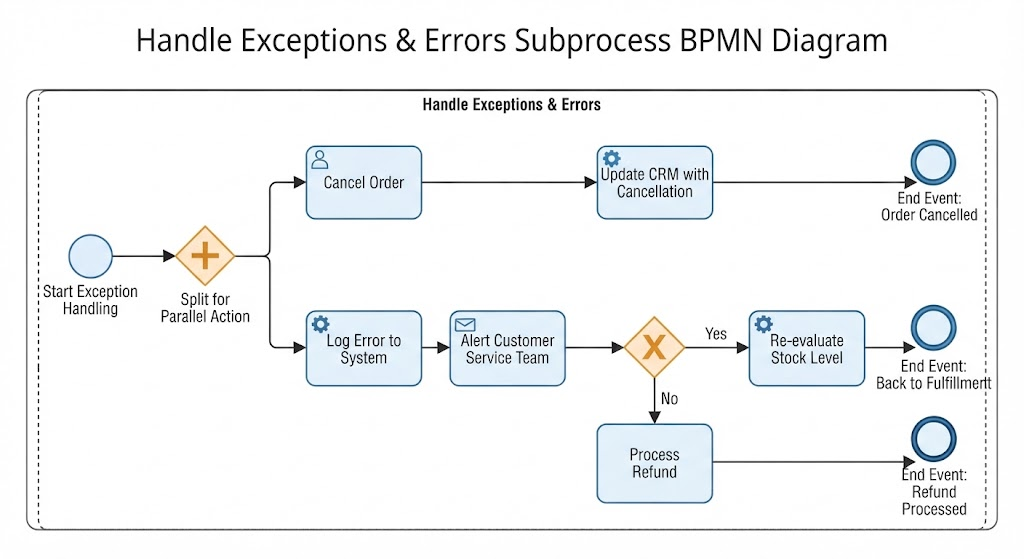
Handle Exception and Errors Sub-Process
Example 2: Order Fulfillment
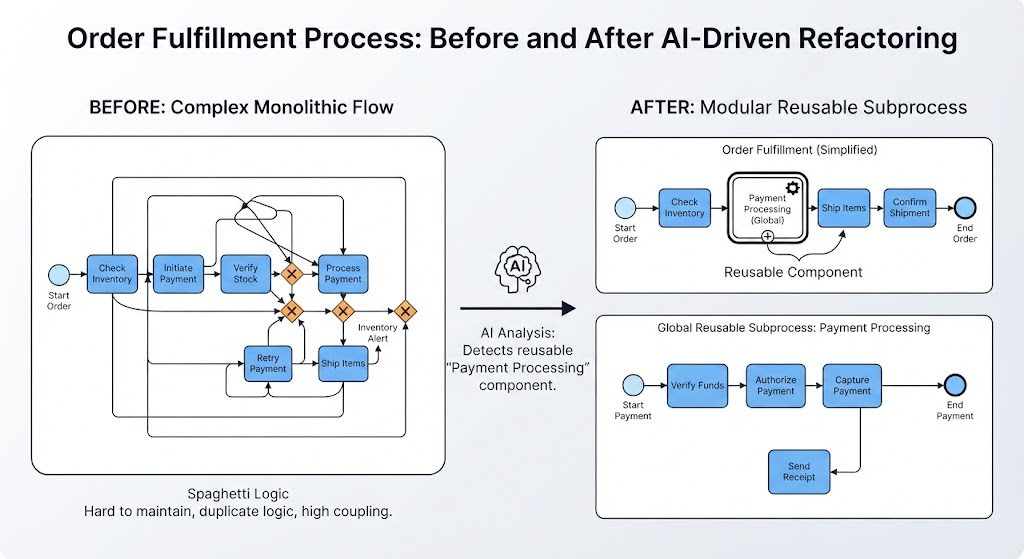
Before: Complex gateways intertwining inventory checks, payment processing, and shipping logistics.
AI Suggestion: The AI detects that “Payment Processing” is a reusable component used in other processes (e.g., refunds, subscriptions).
After: “Payment Processing” is extracted into a global reusable subprocess. Any updates to payment logic now only need to be made in one place, reducing maintenance effort and ensuring consistency.
Conclusion
Taming spaghetti diagrams isn’t just about aesthetics; it’s about creating maintainable, scalable, and understandable process models. By embracing intelligent subprocess decomposition, organizations can bridge the gap between high-level business strategy and detailed technical implementation. Visual Paradigm’s AI-driven tools provide the analytical power needed to identify optimal decomposition boundaries, turning chaotic workflows into clean, modular architectures. As you refine your BPMN practices, remember that AI is not a replacement for human judgment but a powerful assistant that accelerates the journey from complexity to clarity.
Reference Resources: Visual Paradigm Tooling
- AI BPMN Diagram Generator: Professional BPD Tool: Explains how to generate BPMN diagrams from text using AI in the Visual Paradigm desktop application.
- Comprehensive Guide to BPMN, Visual Paradigm Tooling, AI, and Ecosystem: Covers BPMN fundamentals and the ecosystem, with practical AI-generated BPMN examples like employee onboarding.
- How to Create BPMN Business Process Diagrams in Visual Paradigm: A step-by-step tutorial on drawing BPMN diagrams manually, including creating pools, lanes, tasks, gateways, and using simulation features.
- BPMN Tutorial: Visual Paradigm Tooling, AI Chatbot & Ecosystem: Details the AI Chatbot capabilities for generating and refining diagrams via conversational commands.
- AI Business Process Diagram Generator Update: Highlights the AI BPMN generator’s ability to produce complex, multi-pool diagrams from simple text prompts.
- Mastering Business Process Modeling: A Complete Guide to BPMN and AI: A comprehensive guide on BPMN basics and using the AI generator to create diagrams from natural language descriptions.
- Creating Your First BPMN Diagram in Visual Paradigm: A beginner-friendly tutorial covering essential BPMN concepts like events, gateways, and swimlanes, with practical tips.
- BPMN 2.0 Business Process Modeling Beginner’s Guide: Offers a step-by-step guide for beginners, including AI prompt strategies for effective BPMN generation.
- How to Draw BPMN Diagram?: A visual tutorial on using Visual Paradigm’s resource catalog to efficiently draw BPMN diagrams and add gateways and events.
- Mastering BPMN: A Comprehensive Tutorial with Visual Paradigm, AI Chatbot, and Ecosystem: Discusses how the AI chatbot enables rapid, iterative BPMN modeling through plain language commands.