Introduction
Process modeling is a fundamental discipline in business analysis and management that involves capturing an ordered sequence of business activities along with their supporting information. At its core, process modeling helps organizations understand how they pursue their objectives by documenting the workflows, decision points, and interactions that drive business value.
Business Process Model and Notation (BPMN) is the industry-standard graphical notation for specifying business processes. Developed by the Object Management Group (OMG), BPMN provides a comprehensive framework that supports multiple levels of process abstraction—from high-level overviews to executable models.
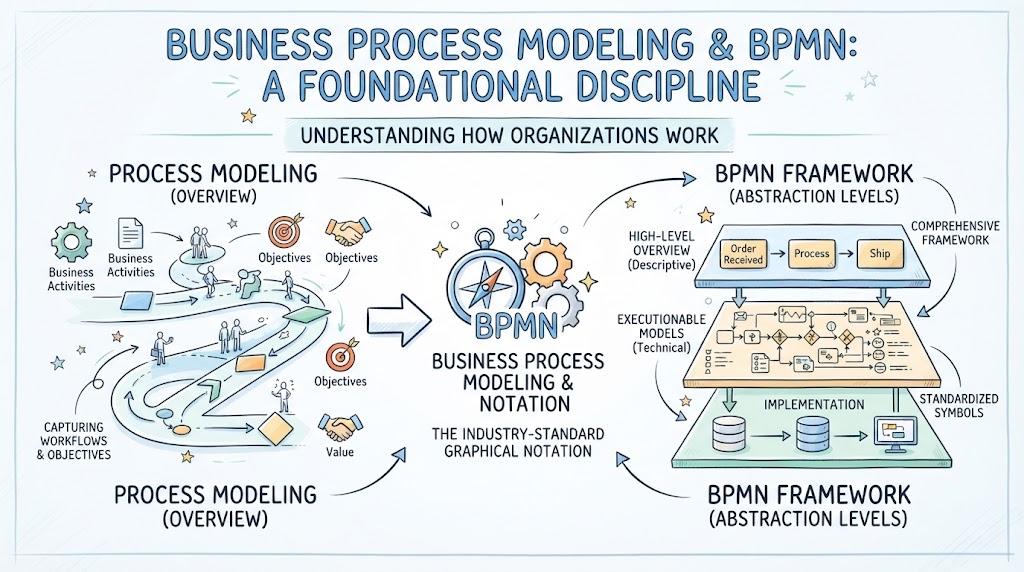
The Three Levels of Process Modeling
Understanding the hierarchy of process modeling is essential for applying BPMN effectively. Each level serves different purposes and audiences within an organization.
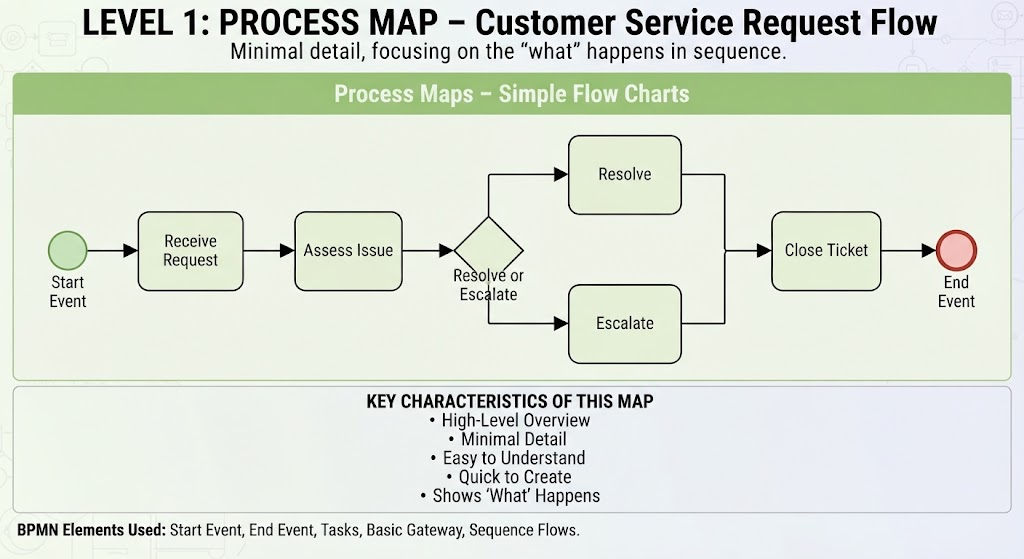
1. Process Maps – Simple Flow Charts
Purpose: Provide a high-level overview of business activities
Characteristics:
-
Visual representation of the main activities in sequence
-
Minimal detail—focuses on “what” happens rather than “how”
-
Easy to understand for stakeholders at all levels
-
Quick to create and modify
BPMN Elements Used:
-
Tasks (basic activities)
-
Start and End Events
-
Sequence Flows (arrows showing order)
-
Basic Gateways for simple decisions
When to Use:
-
Initial process discovery workshops
-
Executive presentations
-
Identifying major process boundaries
-
Onboarding new team members
Example: A customer service process map might show: Receive Request → Assess Issue → Resolve or Escalate → Close Ticket
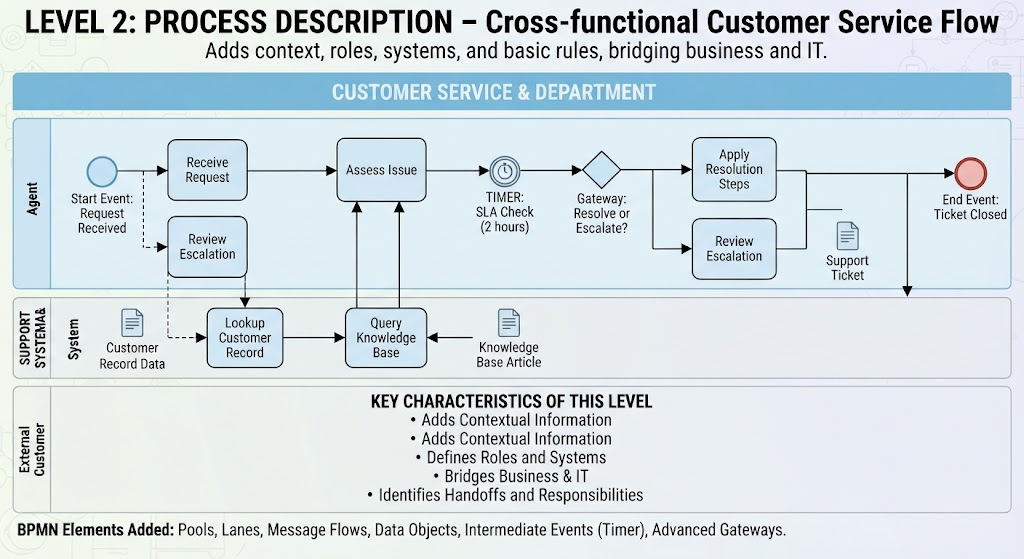
2. Process Descriptions – Extended Flow Charts
Purpose: Add contextual information without full operational detail
Characteristics:
-
Builds upon process maps with additional metadata
-
Includes roles, systems, and basic rules
-
Still not detailed enough for automation or simulation
-
Bridges communication between business and IT
BPMN Elements Added:
-
Pools and Lanes (to show who performs each activity)
-
Message Flows (interactions between participants)
-
Data Objects (information used or produced)
-
More sophisticated Gateways (exclusive, parallel, inclusive)
-
Intermediate Events (timers, messages, errors)
When to Use:
-
Cross-functional process documentation
-
Identifying handoffs and responsibilities
-
Preparing for system integration discussions
-
Compliance and audit documentation
Example: The same customer service process now shows which department handles each step, what systems are consulted, and what documents are generated.
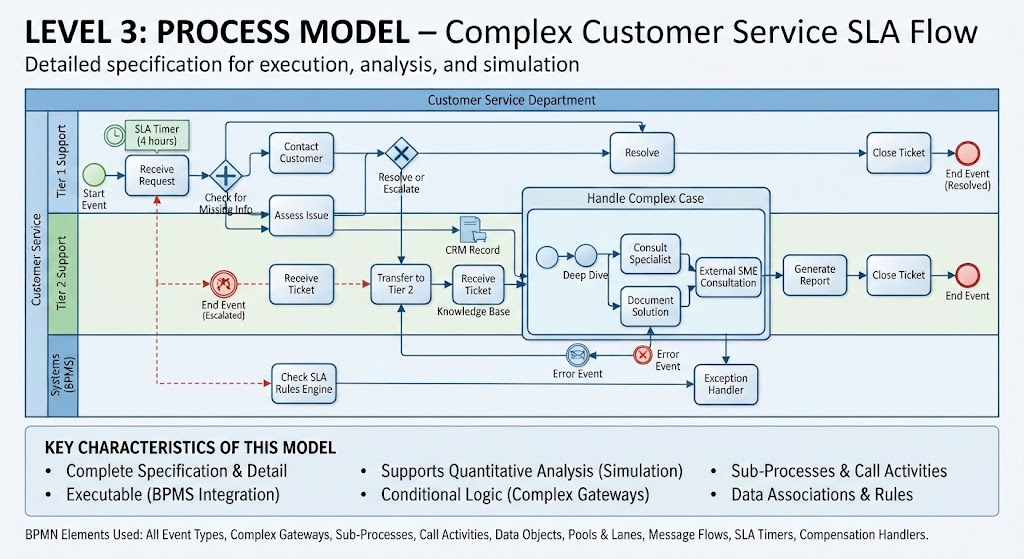
3. Process Models – Fully Defined Processes
Purpose: Enable analysis, simulation, and execution
Characteristics:
-
Complete specification with all necessary details
-
Can be executed by workflow engines (if using executable subset)
-
Supports quantitative analysis (cycle time, resource utilization)
-
Enables what-if scenarios and optimization
BPMN Elements Added:
-
All event types (start, intermediate, end; message, timer, error, signal, etc.)
-
Complex gateways with conditions and expressions
-
Sub-processes (collapsed and expanded)
-
Call Activities (reusable process components)
-
Transaction sub-processes
-
Compensation handlers
-
Detailed data associations and input/output specifications
When to Use:
-
Business process automation initiatives
-
Performance analysis and bottleneck identification
-
Regulatory compliance requiring precise documentation
-
Training materials for complex operational procedures
-
Integration with Business Process Management Systems (BPMS)
Example: The customer service process includes SLA timers, escalation rules with specific conditions, integration points with CRM and knowledge base systems, and exception handling paths.
Core BPMN Concepts
Basic Building Blocks
Events
Events represent something that happens during a process:
-
Start Events: Trigger the process (message, timer, signal, etc.)
-
Intermediate Events: Occur during the process (delay, receive message, throw error)
-
End Events: Conclude the process (terminate, send message, compensate)
Activities
Activities represent work performed:
-
Tasks: Atomic units of work (user task, service task, script task, etc.)
-
Sub-processes: Compound activities that can be expanded for detail
-
Call Activities: Reference to reusable global processes
Gateways
Gateways control the flow of the process:
-
Exclusive Gateway (XOR): One path only based on conditions
-
Parallel Gateway (AND): All paths execute simultaneously
-
Inclusive Gateway (OR): One or more paths based on conditions
-
Event-based Gateway: Path chosen by which event occurs first
Connecting Objects
-
Sequence Flow: Shows order of activities within a process
-
Message Flow: Shows communication between participants (pools)
-
Association: Links artifacts (data, text) to flow objects
Swimlanes
-
Pools: Represent participants (organizations, departments, systems)
-
Lanes: Sub-divisions within pools (roles, teams, individuals)
Best Practices for BPMN Modeling
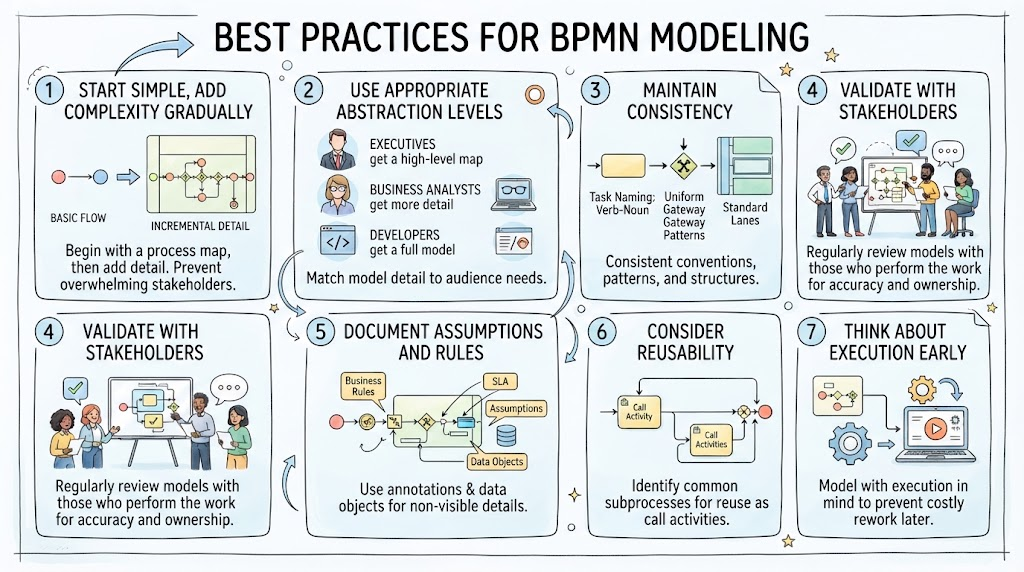
1. Start Simple, Add Complexity Gradually
Begin with a process map to establish the backbone, then incrementally add detail. This prevents overwhelming stakeholders and ensures alignment on the fundamental flow before diving into exceptions.
2. Use Appropriate Abstraction Levels
Match the model detail to your audience:
-
Executives need process maps
-
Business analysts need process descriptions
-
Developers and BPMS administrators need full process models
3. Maintain Consistency
-
Use consistent naming conventions for tasks and events
-
Apply uniform gateway patterns across similar decision points
-
Standardize pool and lane structures for comparable processes
4. Validate with Stakeholders
Regularly review models with those who perform the work. Their feedback ensures accuracy and builds ownership of the documented process.
5. Document Assumptions and Rules
Use annotations and data objects to capture business rules, SLAs, and assumptions that aren’t immediately visible in the diagram.
6. Consider Reusability
Identify common subprocesses that can be modeled once and referenced multiple times through call activities.
7. Think About Execution Early
Even if you’re not automating immediately, model with execution in mind. This prevents costly rework later and ensures your models remain practical.
Common Pitfalls to Avoid
❌ Over-modeling: Adding unnecessary detail that obscures the main flow
❌ Under-modeling: Missing critical decision points or exception paths
❌ Ignoring exceptions: Only modeling the “happy path” without error handling
❌ Mixing levels: Combining high-level and detailed elements inconsistently
❌ Neglecting data flows: Failing to show what information moves through the process
❌ Poor naming: Using vague or technical labels that business users don’t understand
Practical Application Framework
Step 1: Discovery
-
Identify process boundaries (start and end points)
-
Interview stakeholders to understand current state
-
Create initial process map
Step 2: Elaboration
-
Add participants (pools/lanes)
-
Include key data objects and documents
-
Map decision points with gateways
-
Develop process description
Step 3: Refinement
-
Add events (timers, messages, errors)
-
Define conditions on gateways
-
Model exception and compensation paths
-
Incorporate performance metrics
Step 4: Validation
-
Walk through scenarios with stakeholders
-
Verify completeness and accuracy
-
Check for bottlenecks and inefficiencies
-
Finalize process model
Step 5: Implementation & Maintenance
-
Deploy to BPMS if applicable
-
Monitor actual performance against model
-
Update model as processes evolve
-
Version control changes
Conclusion
BPMN’s strength lies in its flexibility to support all three levels of process modeling. Whether you’re creating a simple process map for stakeholder alignment, a detailed process description for cross-functional understanding, or a fully executable process model for automation, BPMN provides the notation and semantics to communicate effectively.
By understanding these levels and applying BPMN appropriately, organizations can improve process transparency, enable continuous improvement, facilitate automation, and ultimately achieve their business objectives more effectively.
Remember: The best process model is not the most complex one—it’s the one that serves its intended purpose and audience while remaining maintainable and accurate.