


Introduction
In the modern enterprise, the gap between high-level business strategy and technical execution is often where projects stall. Business stakeholders speak in narratives and outcomes, while engineering teams require precise, structured specifications. Traditionally, bridging this divide involved manual translation, prone to errors and versioning nightmares.
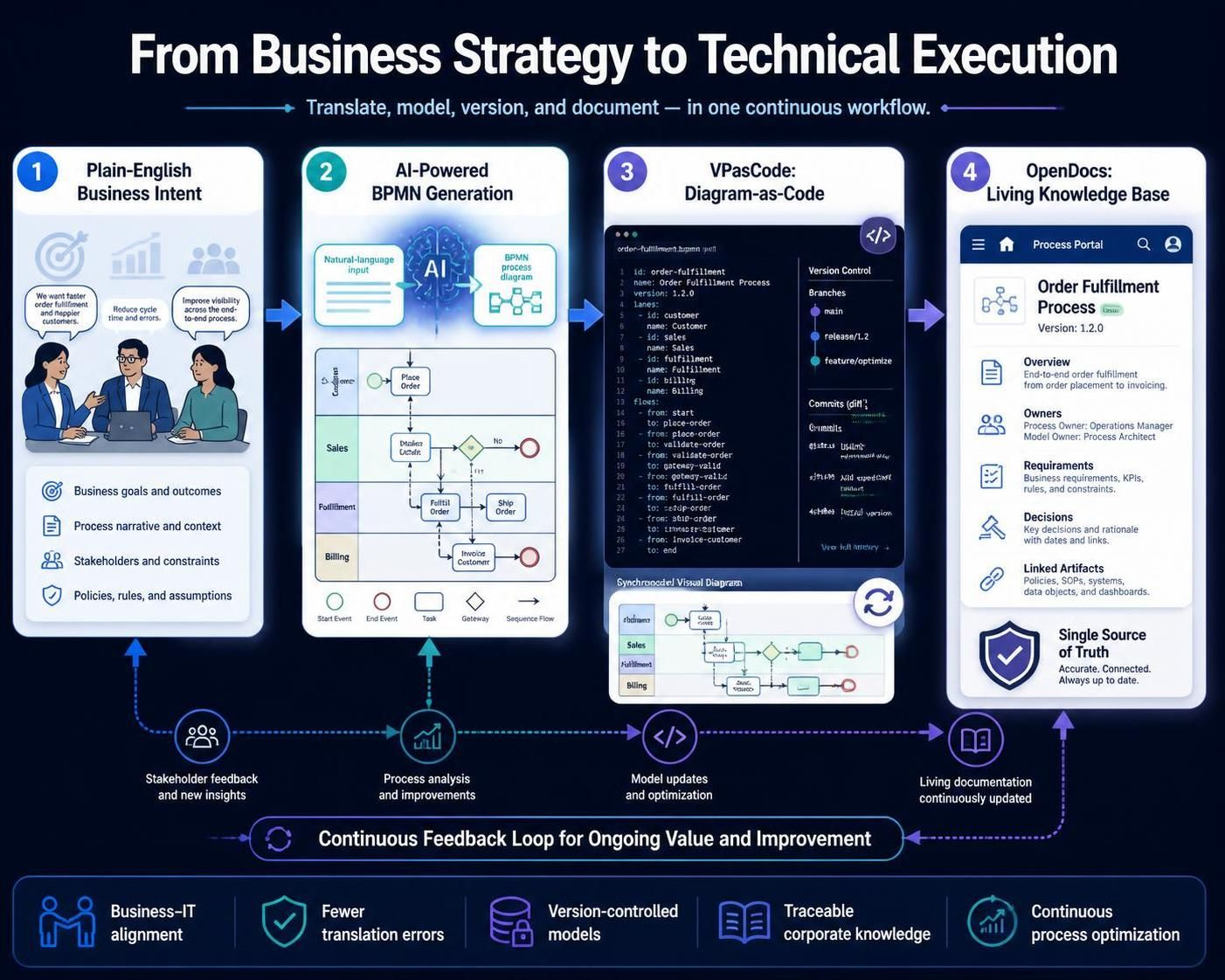
Visual Paradigm has redefined this workflow by integrating artificial intelligence directly into its enterprise-grade modeling environment. By combining AI-powered BPMN generation, Diagram-as-Code editing (VPasCode), and integrated knowledge management (OpenDocs), organizations can now transform plain-English process descriptions into living, code-backed technical documentation. This guide explores how to leverage this end-to-end pipeline to streamline process optimization, ensure business-to-IT alignment, and maintain a single source of truth for corporate knowledge.
Core BPMN Modeling Features
Visual Paradigm provides a comprehensive environment built around the BPMN 2.0 standard, designed to make complex process modeling accessible and efficient.
Intuitive BPMN 2.0 Modeler
At the heart of the suite is a user-friendly, drag-and-drop interface that supports all standard BPMN 2.0 notations. Users can easily manipulate flow objects (events, activities, gateways), connecting objects, swimlanes (pools and lanes), and data items. This intuitive design lowers the barrier to entry for business analysts while maintaining the rigor required by technical architects.
AI-Powered Diagram Generation
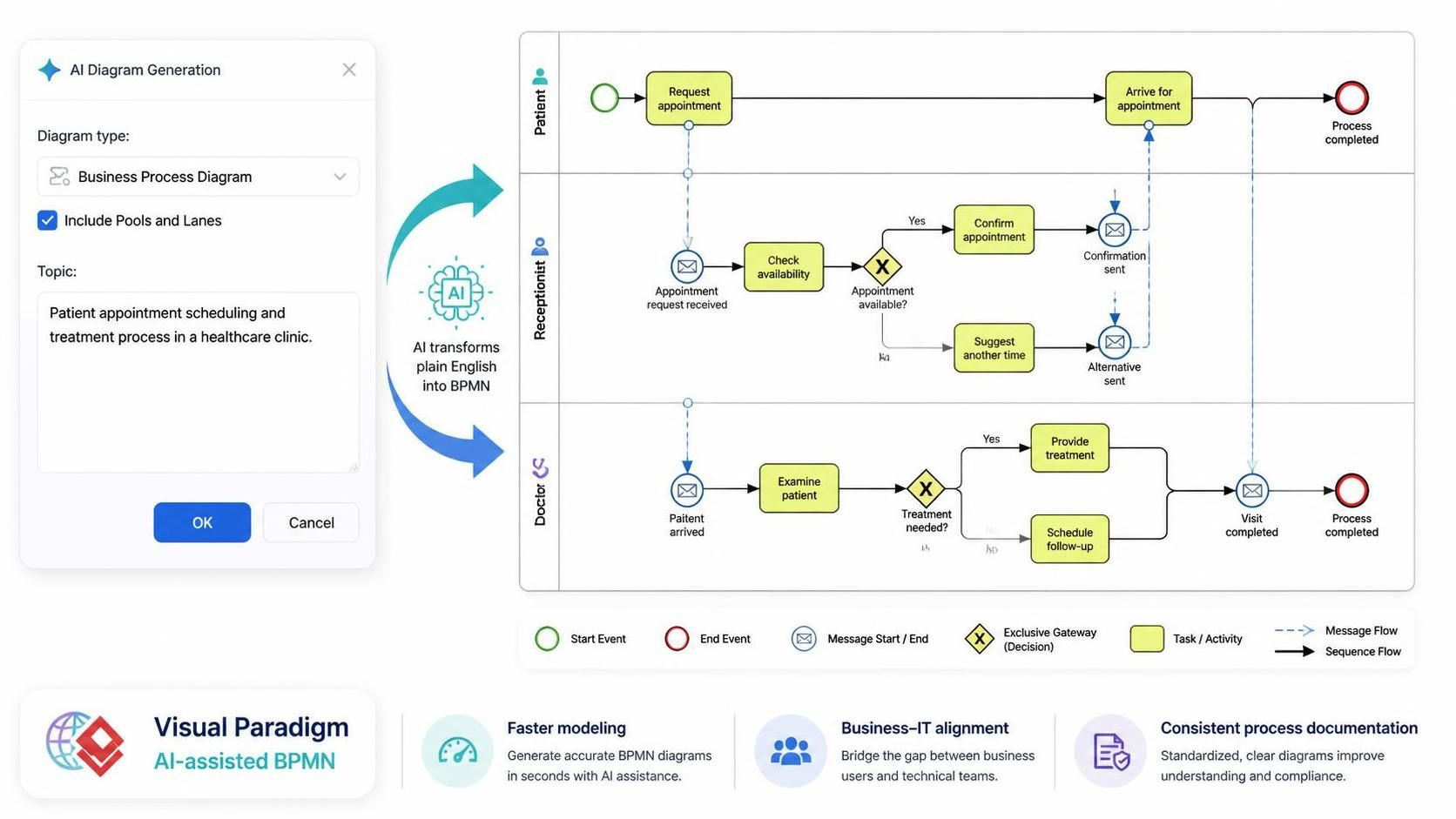
One of the most transformative features is the ability to automatically convert plain-English process narratives into fully structured, standards-compliant BPMN diagrams. The AI handles the heavy lifting of automated swimlane routing and gateway logic, allowing users to focus on the process logic rather than the syntactic details of the diagram.
Process Drill-Down
To manage complexity, Visual Paradigm allows users to collapse or expand sub-processes. This feature links high-level macro workflows down to detailed lower-level task flows, enabling stakeholders to view the “big picture” without losing access to granular operational details.
Advanced Analytical and Operational Tools
Once a process is modeled, Visual Paradigm offers robust tools to analyze, simulate, and document the workflow.
Process Animation & Simulation
Users can visually simulate workflow execution in real-time or custom time scales. This capability is crucial for evaluating human or device resource allocation, identifying bottlenecks, tracking queue times, and calculating cost efficiency before implementation.
Automatic Matrix Generation
The tool instantly derives RACI (Responsible, Accountable, Consulted, Informed) and CRUD (Create, Read, Update, Delete) matrices directly from the elements within a Business Process Diagram (BPD). This automation ensures that accountability and data permissions are accurately mapped to the process structure.
Working Procedure Editor
For detailed operational guidance, the Working Procedure Editor captures specific procedures for individual workflow tasks. It can export complete, unified process manuals, ensuring that documentation remains synchronized with the visual model.
Ecosystem Integration
Visual Paradigm does not exist in a vacuum; it integrates seamlessly with other modeling standards and business practices.
-
Cross-Standard Mapping: Process flows can be integrated with complementary modeling standards, including UML system architecture, CMMN (Case Management Model and Notation), decision tables, and agile user story maps.
-
As-Is and To-Be Modeling: The platform facilitates business process re-engineering by maintaining baseline operational views side-by-side with target optimization models, making it easy to visualize and plan improvements.
Primary Business Usages
-
Process Optimization: Standardizing operational workflows to uncover redundancies, reduce execution costs, and improve customer experience.
-
Business-to-IT Alignment: Translating conceptual operational logic into precise XML specifications and executable models for automated workflow engines.
-
Compliance & Reporting: Defining corporate responsibilities, tracking accountability, and generating custom corporate documentation via the built-in Report Designer.
The AI Advantage: Chatbot and Diagram Generator
Visual Paradigm incorporates artificial intelligence directly into its modeling suite through its AI Diagramming Chatbot and AI BPMN Diagram Generator. These tools translate natural language text into structured visual processes.
Core Capabilities
-
Text-to-BPMN Translation: Converts plain-English process descriptions, problem statements, or operational steps into fully interactive, syntactically correct BPMN 2.0 diagrams in seconds.
-
Automatic Role & Lane Routing: Parses narratives to identify distinct actors, systems, and departments, automatically organizing them into appropriate pools and swimlanes.
-
Intelligent Gateway Logic: Interprets conditional text (such as “if/else” conditions or parallel requirements) to correctly assign exclusive (XOR), parallel (AND), or inclusive gateways with properly labeled sequence flows.
-
Conversational Refinement: Features persistent chat sessions where users can give follow-up instructions to modify flows, tweak logic, or expand specific tasks into detailed sub-processes iteratively.
Workflow & Ecosystem Integration
-
Web and Desktop Availability: Accessible via a web browser for rapid ideation and sharing, or embedded natively within Visual Paradigm Desktop for deep enterprise modeling.
-
Seamless Transition to Analysis: AI-generated drafts transition instantly into the core modeling environment, where teams can run resource simulations, calculate operational costs, or auto-generate RACI and CRUD matrices.
The End-to-End Pipeline: AI Chatbot, VPasCode, and OpenDocs
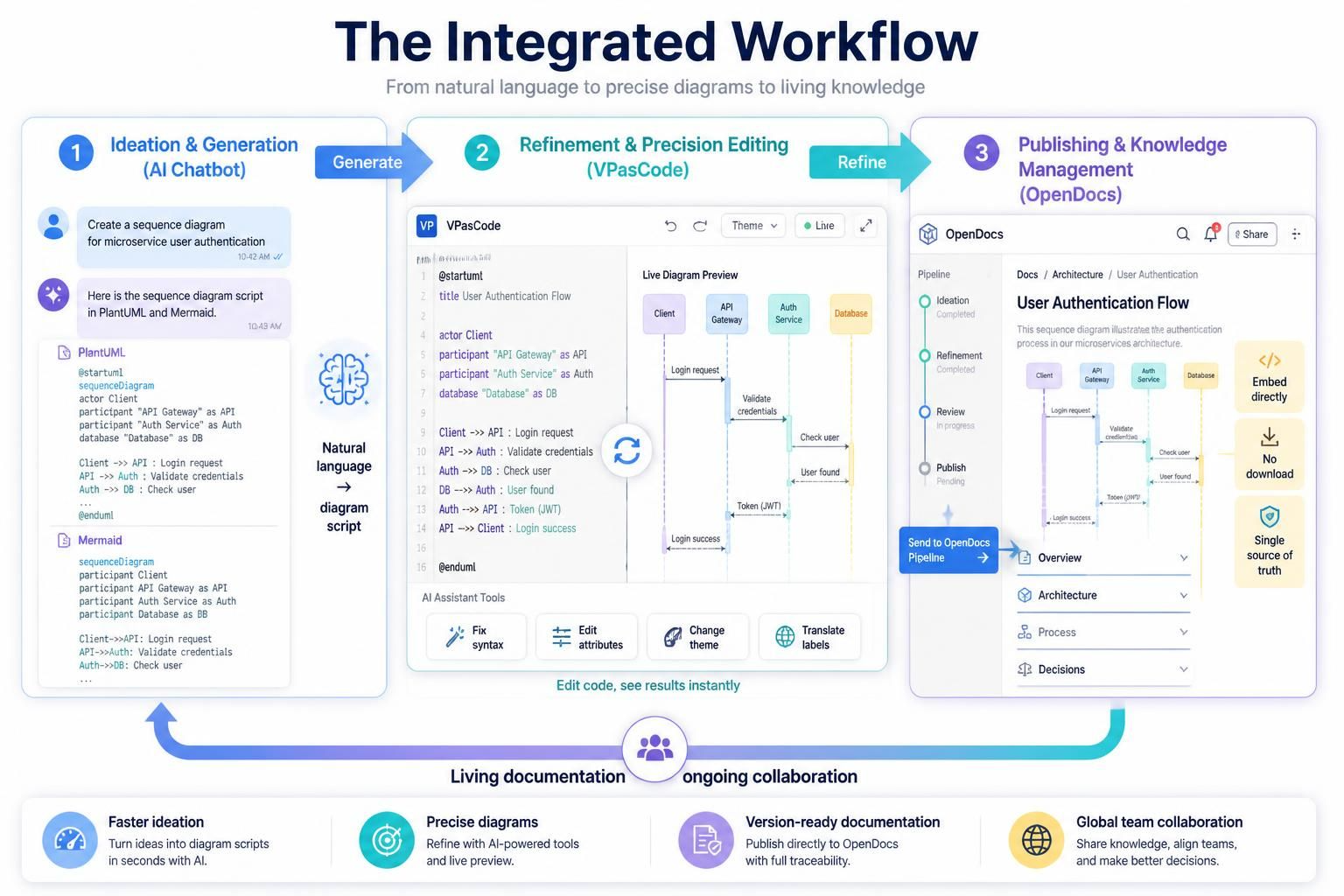
Combining Visual Paradigm’s AI Chatbot, VPasCode, and OpenDocs creates an end-to-end “idea-to-publication” pipeline that transforms natural language thoughts into living, code-backed technical documentation without manual file exporting.
The Integrated Workflow
-
Ideation & Generation (AI Chatbot): Start in the conversational AI workspace. Prompt the chatbot to brainstorm architectures, workflows, or processes (e.g., “Create a sequence diagram for microservice user authentication”). The chatbot translates your natural language requirements into text-based diagram scripts (like PlantUML or Mermaid).
-
Refinement & Precision Editing (VPasCode): Push the generated script directly into VPasCode, Visual Paradigm’s browser-based Diagram-as-Code editor. Here, you can leverage native AI tools to fix syntax errors instantly, modify text attributes conversationally, change themes, or translate labels for global teams. VPasCode provides a split-screen viewport where you code and view the live-rendered graphic simultaneously.
-
Publishing & Knowledge Management (OpenDocs): Once perfected, click “Send to OpenDocs Pipeline” right from the editor. Open your target document page inside OpenDocs (Visual Paradigm’s knowledge-management platform), open the pipeline pane, and embed the diagram seamlessly without downloading or re-uploading image files.
Key Operational Advantages
-
The Revision Loop: When system architectures change, you don’t need to hunt down local files. Click the edit/pencil button on the embedded OpenDocs visual to reopen its source directly in VPasCode, update the script, and resend it to instantly update the live document.
-
Separation of Concerns: Developers and architects focus on writing clean syntax and code structures in VPasCode, while technical writers and product managers enrich the surrounding narrative and contextual guidelines inside OpenDocs.
-
Maintainable Source Control: Because diagrams are backed by text scripts, they function like application code—making them easy to track, version, and collaborate on across teams.
Free PlantUML Editor: VPasCode (AI-Powered Diagram-as-Code)
This video provides a helpful visual walkthrough of live-editing diagram code in VPasCode and routing files directly into documentation suites like OpenDocs.
Key Concepts and Examples
Concept 1: Natural Language to Structured Logic
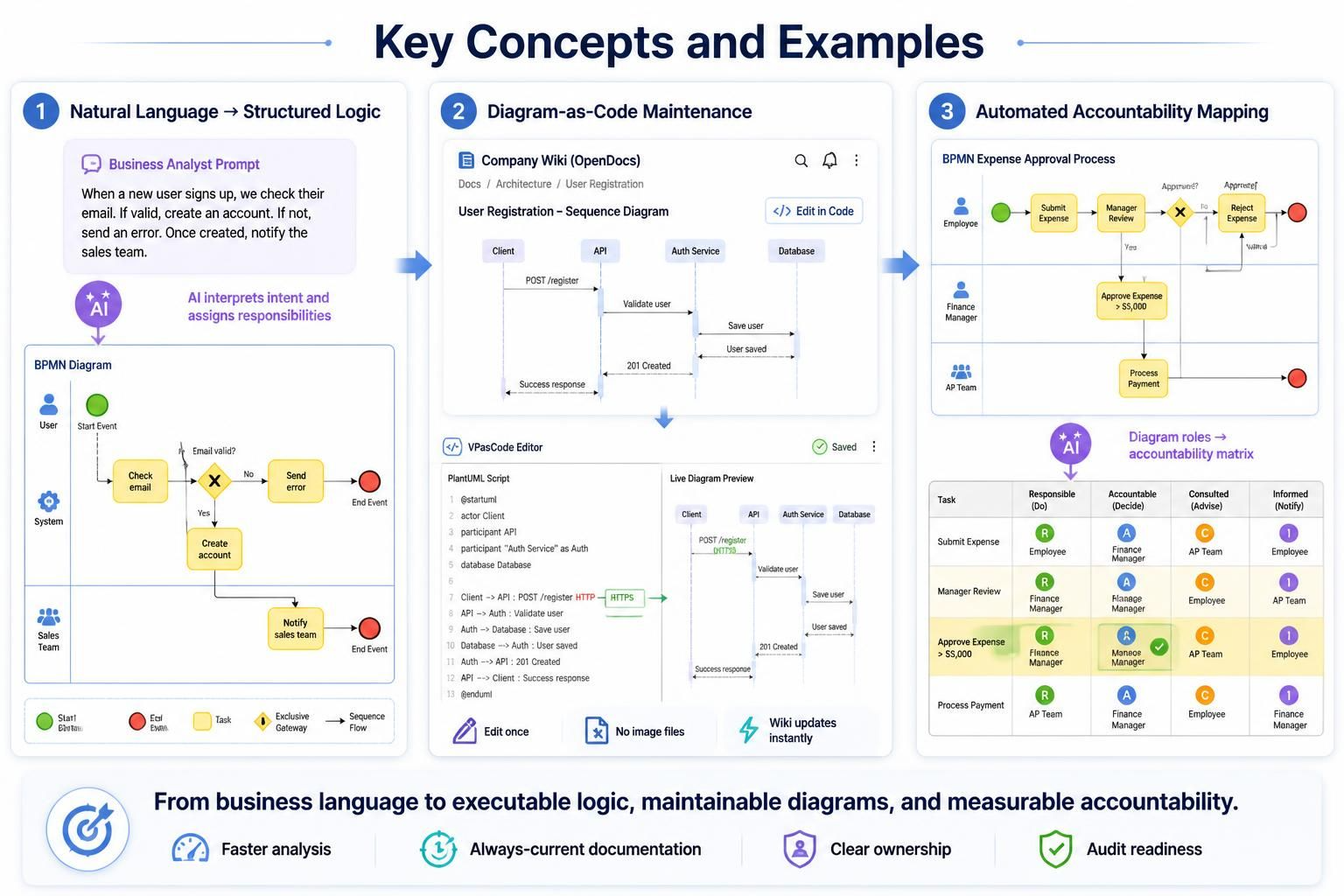
Example: A business analyst describes a customer onboarding process: “When a new user signs up, we check their email. If it’s valid, we create an account. If not, we send an error. Once the account is created, we notify the sales team.”
VP Action: The AI Chatbot interprets this, creating a BPMN diagram with a start event, an exclusive gateway for email validation, two paths (error vs. account creation), and an end event with a notification task. Swimlanes are automatically assigned to “User,” “System,” and “Sales Team.”
Concept 2: Diagram-as-Code Maintenance
Example: A developer needs to update the authentication protocol in a sequence diagram embedded in the company wiki.
VP Action: Instead of redrawing the diagram, the developer clicks the edit button in OpenDocs, which opens VPasCode. They modify the PlantUML script to change HTTP to HTTPS, save, and the diagram in the wiki updates instantly. No image files are exchanged.
Concept 3: Automated Accountability Mapping
Example: A compliance officer needs to know who is responsible for approving expenses over $5,000.
VP Action: Using the BPMN model, the officer uses the “Automatic Matrix Generation” feature to produce a RACI matrix. The tool scans the diagram, identifies the “Approve Expense” task, and lists the actor in the corresponding swimlane as “Accountable.”
Conclusion
Visual Paradigm’s integration of AI-driven modeling, code-based editing, and seamless documentation publishing represents a significant leap forward in enterprise architecture and process management. By automating the translation of natural language into structured BPMN diagrams and maintaining those diagrams as living, code-backed assets, organizations can reduce friction between business and IT, ensure documentation accuracy, and accelerate process optimization. Whether you are a business analyst looking to clarify workflows or a developer aiming to keep technical documentation in sync with code, this pipeline offers a robust, scalable solution for modern enterprise challenges.
Recommended Reading and Resources
-
Comprehensive Guide to BPMN, Visual Paradigm Tooling, AI, and Ecosystem: Official blog post outlining the four pillars of the VP AI ecosystem with practical BPMN examples like Employee Onboarding and Order Fulfillment .
-
Mastering Business Process Modeling: A Complete Guide to BPMN and AI-Powered Diagram Generation: Official guide detailing how to use the AI Business Process Diagram generator, with step-by-step instructions and feature comparisons .
-
From Text to Process Flow: My Hands-On Review of Visual Paradigm’s AI-Powered BPMN Generator: Independent review testing the generator across real-world scenarios (e-commerce, IT support, banking) from a business analyst perspective .
-
AI BPMN Diagram Generator: Professional BPD Tool: Official product page explaining the text-to-diagram feature, how to access it in VP Desktop, and key benefits like standard compliance .
-
BPMN、Visual Paradigm 工具、人工智能与生态系统全面指南: Chinese version of the comprehensive guide, covering BPMN fundamentals and AI-driven generation case studies .
-
From Text to Process Flow: A Hands-On Review of Visual Paradigm’s AI-Powered BPMN Generator: Detailed case study on a hardware retailer’s shipment process, demonstrating how AI handles gateways, parallel execution, and swimlane logic .
-
AI BPMN图生成器:专业BPD工具: Chinese product guide detailing the AI generator’s capabilities, including automatic pool and lane inclusion for cross-functional clarity .
-
我的亲身体验:利用 Visual Paradigm 的 AI 驱动 BPMN 改变工作流程文档: First-hand review of the AI generator’s performance on employee onboarding, customer support, and loan approval scenarios .
-
BPMN 2.0 商业流程建模新手实战指南:运用 Visual Paradigm 与 AI 轻松打造专业流程图: Practical tutorial with prompt writing strategies and advanced optimization techniques using the AI Chatbot for conversational refinement .
-
BPMN 完整实战教程:Visual Paradigm 体验、AI 功能与生态系统深度指南: Series of articles covering the AI-powered BPMN generator launch, with deep dives into ecosystem integration and practical examples .
Related posts:
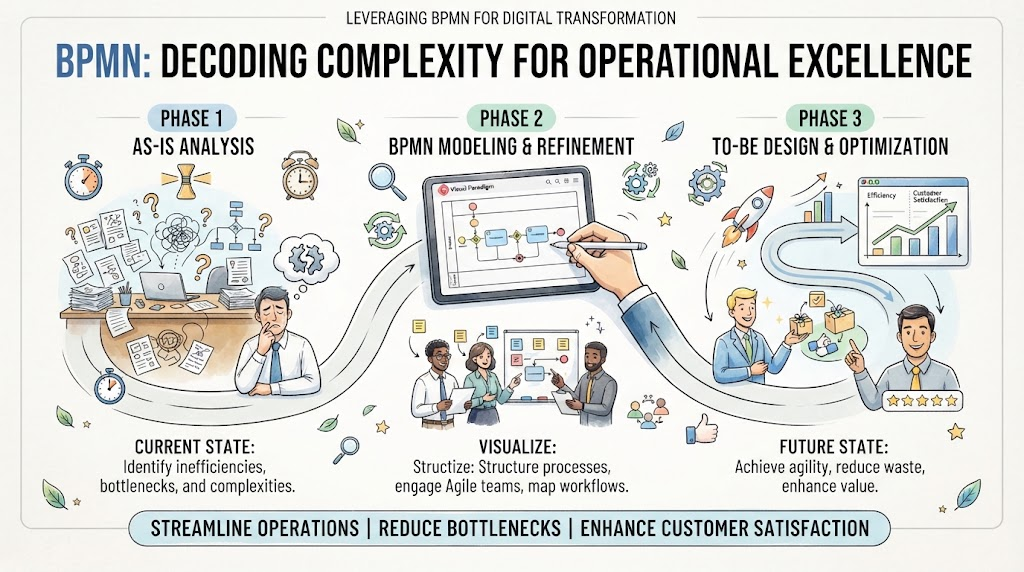 Real-World BPMN Case Studies: How Companies Streamline Operations with Process Modeling
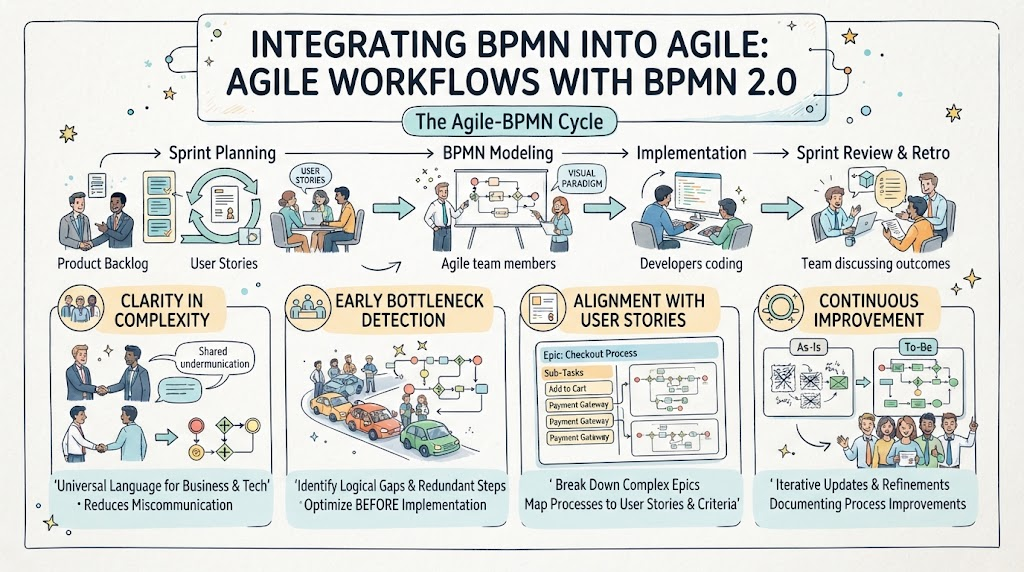 BPMN for Agile Teams: Integrating Process Modeling into Sprint Planning
 Mastering Intermediate Events in BPMN: A Comprehensive Guide to Process Triggers and Flow Control
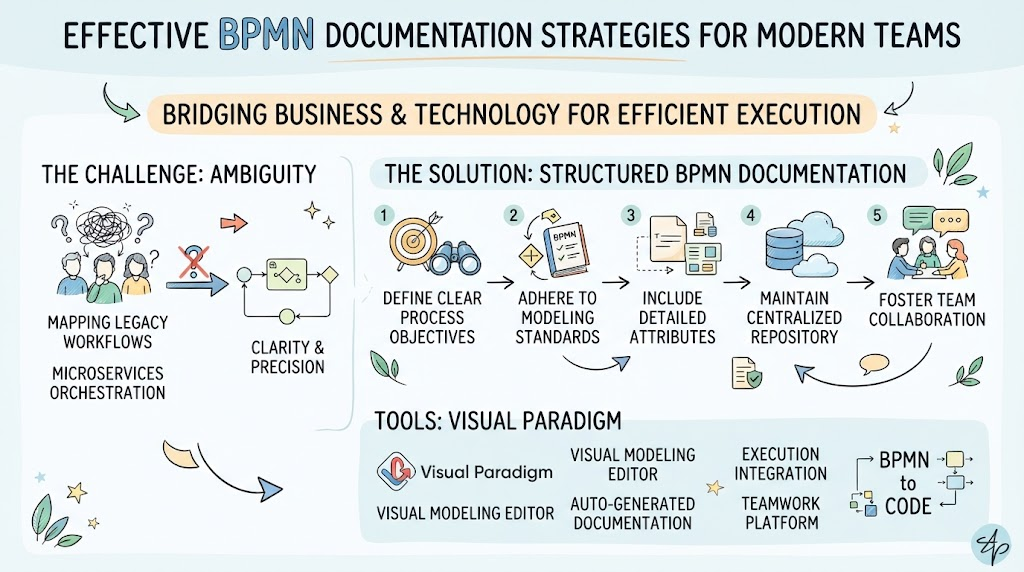 BPMN Gateways: Parallel Splitting and Merging Example