


Introduction
In the rapidly evolving landscape of modern business, efficiency is not just a metric—it’s a survival strategy. Organizations often find themselves bogged down by legacy workflows, redundant tasks, and communication silos that stifle growth and erode customer satisfaction. Business Process Improvement (BPI) offers a strategic pathway out of this operational fog, but you cannot improve what you do not understand.
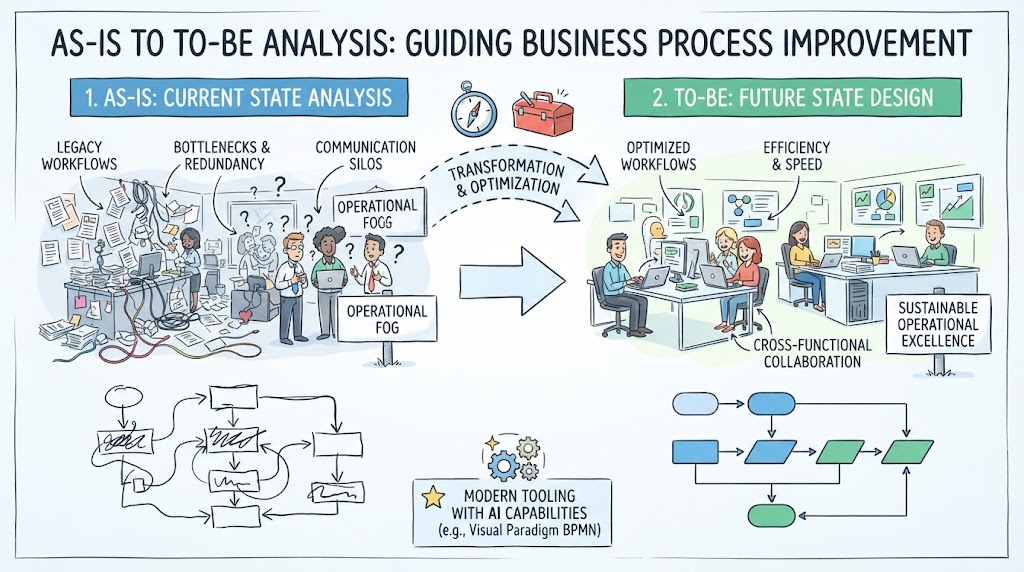
This is where As-Is and To-Be analysis becomes indispensable. It is the compass that guides organizations from their current, often flawed state (As-Is) to a desired, optimized future state (To-Be). This guide explores the methodology behind this critical analysis, providing a structured approach to identifying inefficiencies, designing superior workflows, and leveraging modern tooling like Visual Paradigm BPMN with AI capabilities to accelerate transformation. Whether you are facing performance issues, implementing new technology, or undergoing organizational change, mastering As-Is and To-Be analysis is the first step toward sustainable operational excellence.
Key Concepts: Understanding the Core Framework
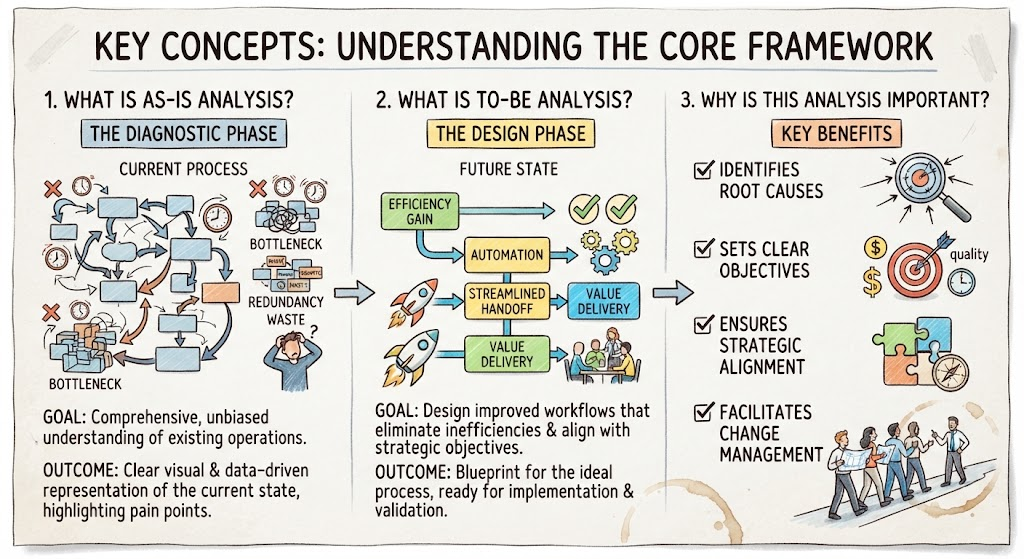
1. What is As-Is Analysis?
As-Is Analysis is the diagnostic phase. It involves a rigorous examination of current processes as they actually exist, not necessarily how they are documented or intended to work.
-
Goal: Gain a comprehensive, unbiased understanding of existing operations.
-
Focus: Mapping workflows, identifying bottlenecks, redundancies, waste, and pain points.
-
Outcome: A clear visual and data-driven representation of the current state, highlighting specific areas requiring improvement.
2. What is To-Be Analysis?
To-Be Analysis is the design phase. It focuses on envisioning and constructing the future state of processes after improvements have been applied.
-
Goal: Design improved workflows that eliminate identified inefficiencies and align with strategic objectives.
-
Focus: Innovation, automation, streamlining handoffs, and enhancing value delivery.
-
Outcome: A blueprint for the ideal process, ready for implementation, testing, and validation.
3. Why is This Analysis Important?
-
Identifies Root Causes: Moves beyond symptoms to uncover why inefficiencies exist.
-
Sets Clear Objectives: Defines measurable goals for cost reduction, quality improvement, or speed enhancement.
-
Ensures Strategic Alignment: Guarantees that process changes support broader business goals and customer expectations.
-
Facilitates Change Management: Provides a clear narrative for stakeholders, reducing resistance by showing the “why” and “how” of changes.
When to Conduct As-Is and To-Be Analysis
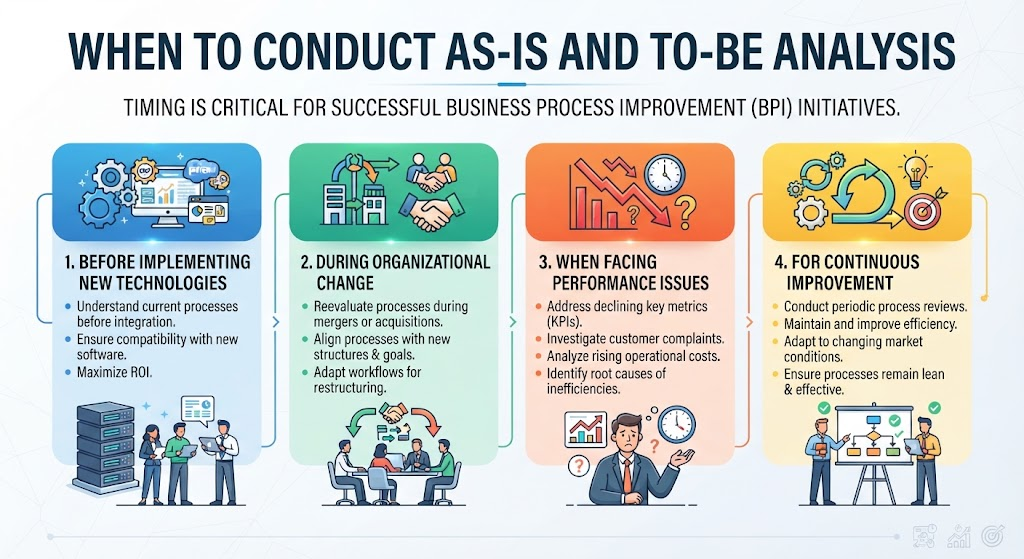
Timing is critical for the success of any BPI initiative. Consider conducting this analysis in the following scenarios:
-
Before Implementing New Technologies: Integrating ERP, CRM, or other software requires a clear understanding of current processes to ensure compatibility and maximize ROI.
-
During Organizational Change: Mergers, acquisitions, or restructuring necessitate reevaluating processes to align with new structures and goals.
-
When Facing Performance Issues: Declining metrics, customer complaints, or rising operational costs signal the need for a deep dive into root causes.
-
For Continuous Improvement: Periodic reviews help maintain efficiency and adapt to changing market conditions, ensuring processes remain lean and effective.
Who Should Be Involved?
Successful analysis requires a cross-functional approach:
-
Process Owners & Stakeholders: Those who live the process daily provide invaluable insights into real-world challenges and nuances.
-
Cross-Functional Teams: Representatives from different departments (e.g., sales, production, logistics) ensure a holistic view and break down silos.
-
Business Analysts: Skilled facilitators who use methodologies and tools to map, analyze, and design processes objectively.
-
Leadership: Executive sponsorship ensures alignment with strategic objectives and provides the authority needed to drive change.
How to Conduct As-Is and To-Be Analysis: A Step-by-Step Guide
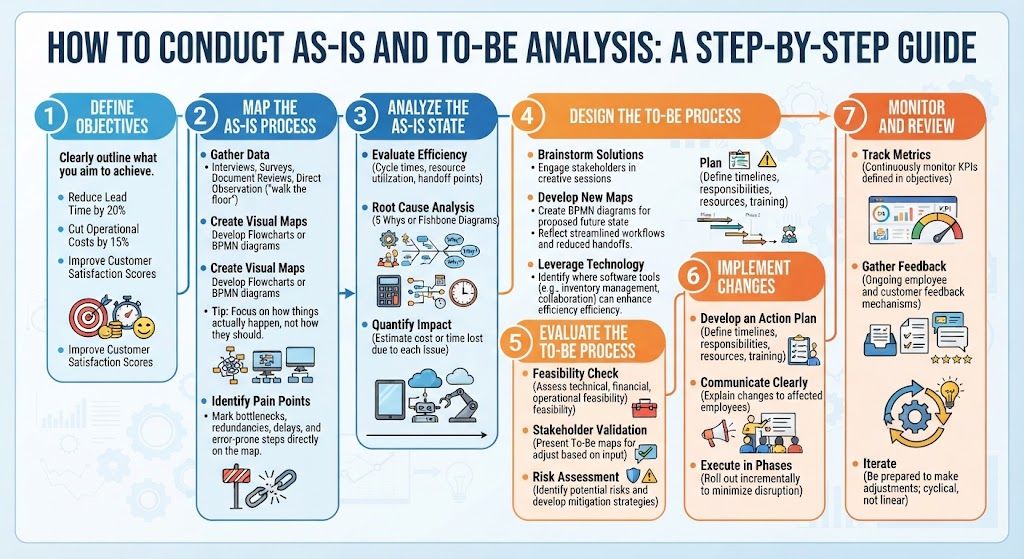
Phase 1: Define Objectives
Clearly outline what you aim to achieve. Examples include reducing lead time by 20%, cutting operational costs by 15%, or improving customer satisfaction scores. Specific, measurable goals keep the project focused.
Phase 2: Map the As-Is Process
-
Gather Data: Use interviews, surveys, document reviews, and direct observation (“walk the floor”) to collect accurate information.
-
Create Visual Maps: Develop flowcharts or BPMN diagrams to visualize current workflows. Tip: Focus on how things actually happen, not how they should happen.
-
Identify Pain Points: Mark bottlenecks, redundancies, delays, and error-prone steps directly on the map.
Phase 3: Analyze the As-Is State
-
Evaluate Efficiency: Assess cycle times, resource utilization, and handoff points.
-
Root Cause Analysis: Use techniques like the “5 Whys” or Fishbone Diagrams to understand why inefficiencies exist.
-
Quantify Impact: Estimate the cost or time lost due to each identified issue.
Phase 4: Design the To-Be Process
-
Brainstorm Solutions: Engage stakeholders in creative sessions to propose improvements. Consider automation, elimination of non-value-added steps, or parallel processing.
-
Develop New Maps: Create BPMN diagrams for the proposed future state. Ensure these maps reflect streamlined workflows and reduced handoffs.
-
Leverage Technology: Identify where software tools (e.g., inventory management systems, collaborative platforms) can enhance efficiency.
Phase 5: Evaluate the To-Be Process
-
Feasibility Check: Assess technical, financial, and operational feasibility.
-
Stakeholder Validation: Present the To-Be maps to key stakeholders for feedback. Adjust based on their input to ensure buy-in.
-
Risk Assessment: Identify potential risks in the new process and develop mitigation strategies.
Phase 6: Implement Changes
-
Develop an Action Plan: Define timelines, responsibilities, resource allocation, and training needs.
-
Communicate Clearly: Explain the changes to all affected employees, emphasizing benefits and addressing concerns.
-
Execute in Phases: Roll out changes incrementally if possible to minimize disruption.
Phase 7: Monitor and Review
-
Track Metrics: Continuously monitor KPIs defined in the objectives phase.
-
Gather Feedback: Establish mechanisms for ongoing employee and customer feedback.
-
Iterate: Be prepared to make adjustments. Process improvement is cyclical, not linear.
Tooling Spotlight: Visual Paradigm BPMN + AI-Powered BPMN
Modern process mapping has been revolutionized by tools that combine standard notation with artificial intelligence. Visual Paradigm is a leading platform in this space, offering robust BPMN (Business Process Model and Notation) capabilities enhanced by AI.
Why Use Visual Paradigm with AI?
-
Accelerated Mapping: AI-powered features can suggest process steps, auto-complete diagrams, or even generate initial drafts from text descriptions, significantly reducing manual effort.
-
Standard Compliance: Ensures your As-Is and To-Be maps adhere to BPMN 2.0 standards, making them universally understandable to stakeholders and technical teams.
-
Simulation & Analysis: Some advanced features allow for process simulation, helping you predict the impact of To-Be changes before implementation.
-
Collaboration: Cloud-based features enable real-time collaboration among cross-functional teams, ensuring everyone is aligned on the current and future states.
Practical Application:
-
For As-Is: Use Visual Paradigm’s interview mode or import existing documentation to quickly draft current workflows. The AI can help identify missing steps or inconsistent notation.
-
For To-Be: Leverage AI suggestions to optimize paths. For example, if the AI detects a sequential approval process that could be parallelized, it can suggest a revised structure.
Case Study: Business Process Improvement at XYZ Manufacturing
Context: XYZ Manufacturing, a mid-sized automotive parts supplier, faced declining customer satisfaction due to delayed order fulfillment and high operational costs caused by production inefficiencies.
Objectives
-
Reduce lead time from order to delivery.
-
Improve product quality by minimizing defects.
-
Increase customer satisfaction scores.
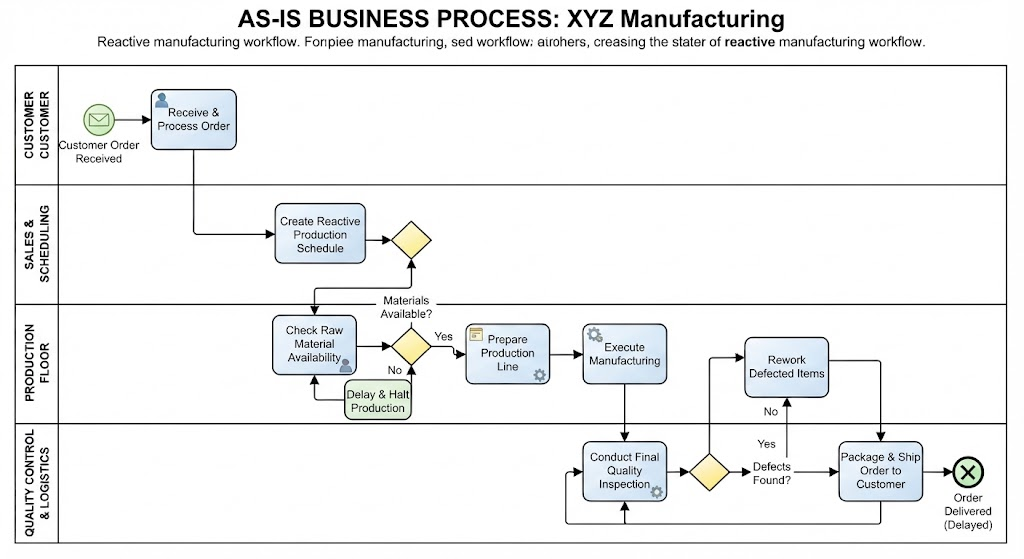
As-Is Analysis Findings
-
Reactive Scheduling: Production was scheduled only after orders arrived, causing delays.
-
Inventory Issues: Inconsistent material levels led to frequent production halts.
-
Quality Gaps: High defect rates resulted in costly rework.
-
Communication Silos: Lack of real-time updates between production, quality, and logistics teams.
To-Be Design
-
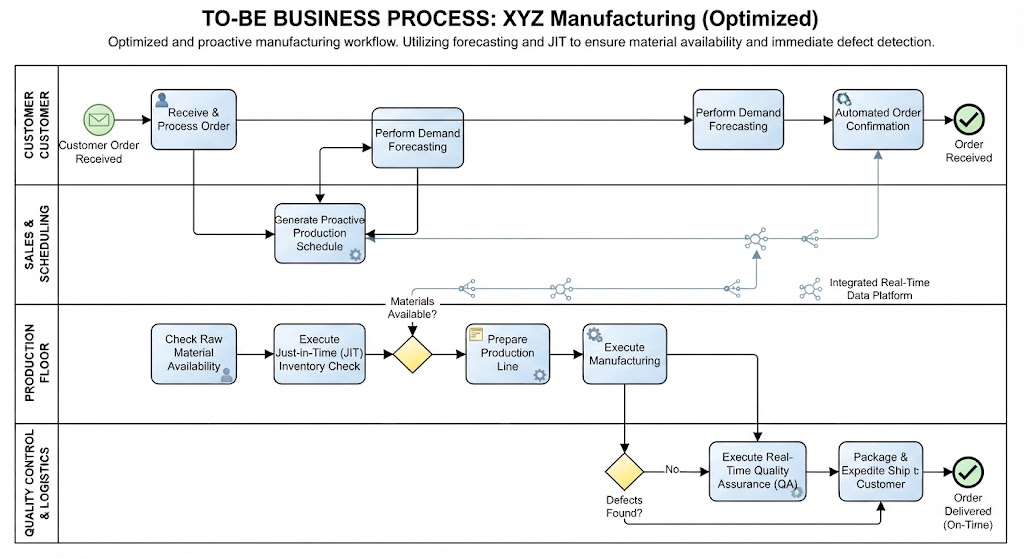
Proactive Scheduling: Implemented demand forecasting tools for proactive production planning.
-
Just-in-Time Inventory: Adopted inventory management software to ensure material availability.
-
Real-Time QMS: Introduced a Quality Management System for immediate defect detection.
-
Collaborative Platform: Deployed software for real-time cross-departmental communication.
Implementation & Results
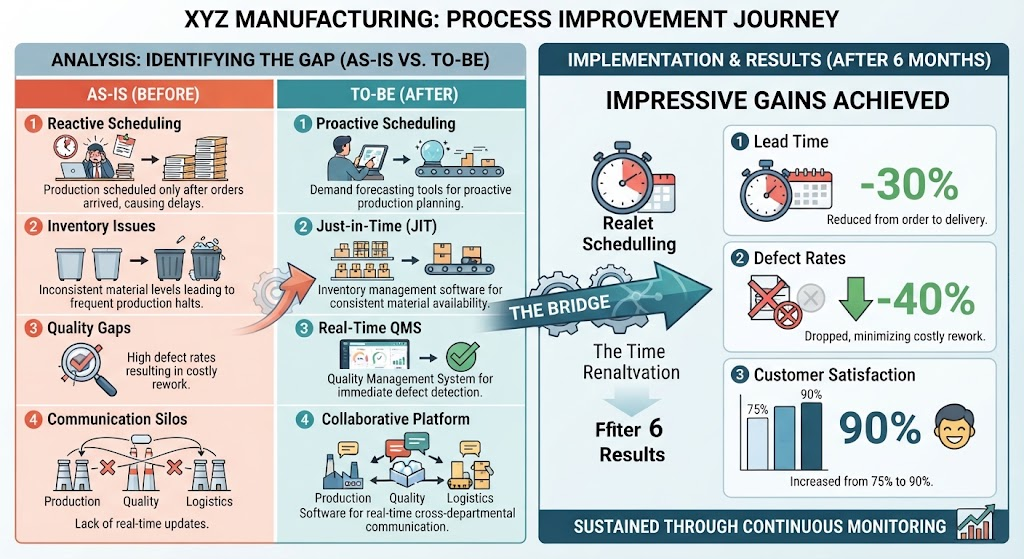
Over six months, XYZ Manufacturing phased in these changes with targeted training. The results were significant:
-
Lead Time: Reduced by 30%.
-
Defect Rates: Dropped by 40%.
-
Customer Satisfaction: Improved from 75% to 90%.
Continuous monitoring was established to sustain these gains, demonstrating the long-term value of structured As-Is and To-Be analysis.
Conclusion
As-Is and To-Be analysis is more than a procedural exercise; it is a strategic imperative for any organization committed to excellence. By methodically diagnosing current weaknesses and designing visionary future states, businesses can unlock significant efficiencies, reduce costs, and deliver superior value to customers.
The key to success lies in engagement—involving the right stakeholders, leveraging data-driven insights, and utilizing powerful tools like Visual Paradigm BPMN with AI to streamline the mapping and design process. Remember, process improvement is not a one-time event but a continuous journey. By embedding As-Is and To-Be analysis into your organizational culture, you ensure that your processes remain agile, efficient, and aligned with your ever-evolving business goals. Start mapping today, and transform chaos into clarity.
BPMN Resources
- AI BPMN Diagram Generator: Professional BPD Tool: Explains how to generate BPMN diagrams from text using AI in the Visual Paradigm desktop application .
- Comprehensive Guide to BPMN, Visual Paradigm Tooling, AI, and Ecosystem: Covers BPMN fundamentals and the ecosystem, with practical AI-generated BPMN examples like employee onboarding .
- How to Create BPMN Business Process Diagrams in Visual Paradigm: A step-by-step tutorial on drawing BPMN diagrams manually, including creating pools, lanes, tasks, gateways, and using simulation features .
- BPMN Tutorial: Visual Paradigm Tooling, AI Chatbot & Ecosystem: Details the AI Chatbot capabilities for generating and refining diagrams via conversational commands .
- AI Business Process Diagram Generator Update: Highlights the AI BPMN generator’s ability to produce complex, multi-pool diagrams from simple text prompts .
- Mastering Business Process Modeling: A Complete Guide to BPMN and AI: A comprehensive guide on BPMN basics and using the AI generator to create diagrams from natural language descriptions .
- Creating Your First BPMN Diagram in Visual Paradigm: A beginner-friendly tutorial covering essential BPMN concepts like events, gateways, and swimlanes, with practical tips .
- BPMN 2.0 Business Process Modeling Beginner’s Guide: Offers a step-by-step guide for beginners, including AI prompt strategies for effective BPMN generation .
- How to Draw BPMN Diagram?: A visual tutorial on using Visual Paradigm’s resource catalog to efficiently draw BPMN diagrams and add gateways and events .
- Mastering BPMN: A Comprehensive Tutorial with Visual Paradigm, AI Chatbot, and Ecosystem: Discusses how the AI chatbot enables rapid, iterative BPMN modeling through plain language commands .