


Introduction
In today’s rapidly evolving business landscape, digital transformation is no longer a luxury—it is a necessity for organizations aiming to stay competitive. The integration of technology with traditional processes enhances efficiency, improves customer experiences, and opens new growth avenues. However, navigating this transformation presents significant challenges, including resistance to change, unclear objectives, and fragmented workflows.
This article outlines strategies for successful digital transformation, emphasizing the critical importance of As-Is, To-Be, and Gap analyses in business improvement. By leveraging powerful tooling like Visual Paradigm, businesses can visualize these states clearly, identify discrepancies, and create actionable roadmaps for success. Whether you are a product manager, business analyst, or IT leader, understanding how to map current realities against future ideals is the first step toward operational excellence.
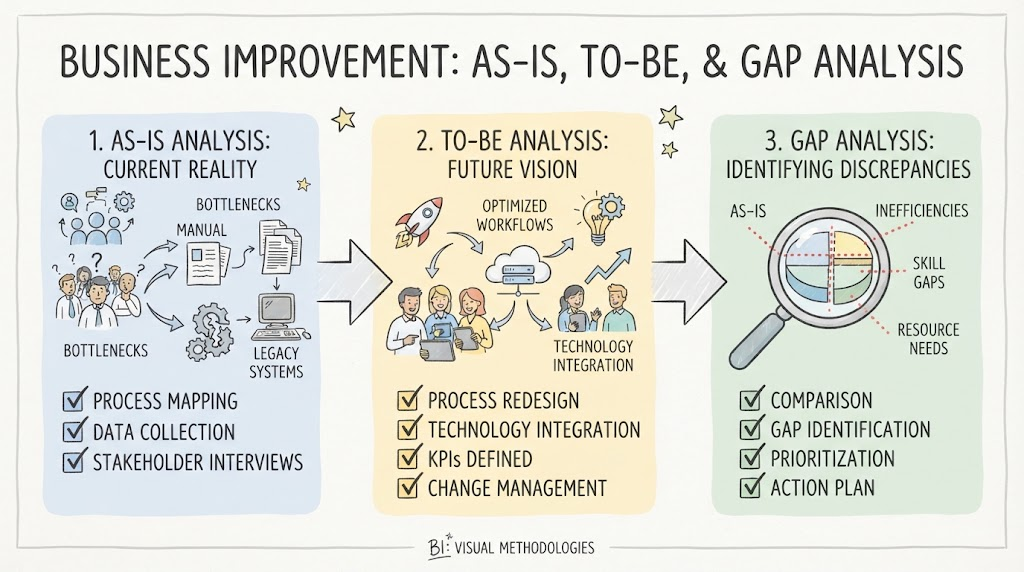
Key Concepts: As-Is, To-Be, and Gap Analysis in Business Improvement
1. As-Is Analysis
-
Definition: A comprehensive examination of existing processes, systems, and workflows.
-
Purpose: Understand current operations to identify areas for enhancement, bottlenecks, and inefficiencies.
-
Methodology:
-
Process Mapping: Create visual representations (e.g., BPMN diagrams) of current workflows to ensure everyone has a shared understanding.
-
Data Collection: Gather quantitative data (cycle times, error rates, cost per transaction) and qualitative data (employee feedback).
-
Stakeholder Interviews: Engage individuals involved in the process for insights, pain points, and practical feedback.
-
2. To-Be Analysis
-
Definition: Envisioning and designing an improved version of existing processes.
-
Purpose: Create a clear vision for how processes should ideally function in the future state.
-
Methodology:
-
Process Redesign: Reimagine workflows to eliminate bottlenecks, reduce waste, and improve flow.
-
Technology Integration: Identify specific technology solutions (automation, AI, cloud services) to enhance processes.
-
Performance Metrics: Define Key Performance Indicators (KPIs) to measure the success of the new process.
-
Change Management: Plan for the transition, including training programs, communication strategies, and support structures.
-
3. Gap Analysis
-
Definition: Comparing As-Is and To-Be states to identify discrepancies or “gaps.”
-
Purpose: Understand the necessary changes, resource requirements, and opportunities for improvement.
-
Methodology:
-
Comparison: Systematically assess the documented As-Is state against the proposed To-Be state.
-
Gap Identification: Pinpoint areas of inefficiency, technology shortcomings, skill deficiencies, or cultural barriers.
-
Prioritization: Rank gaps based on their impact on business goals and the feasibility of closing them.
-
Action Plan: Develop a detailed, phased plan to address identified gaps, assigning owners and timelines.
-
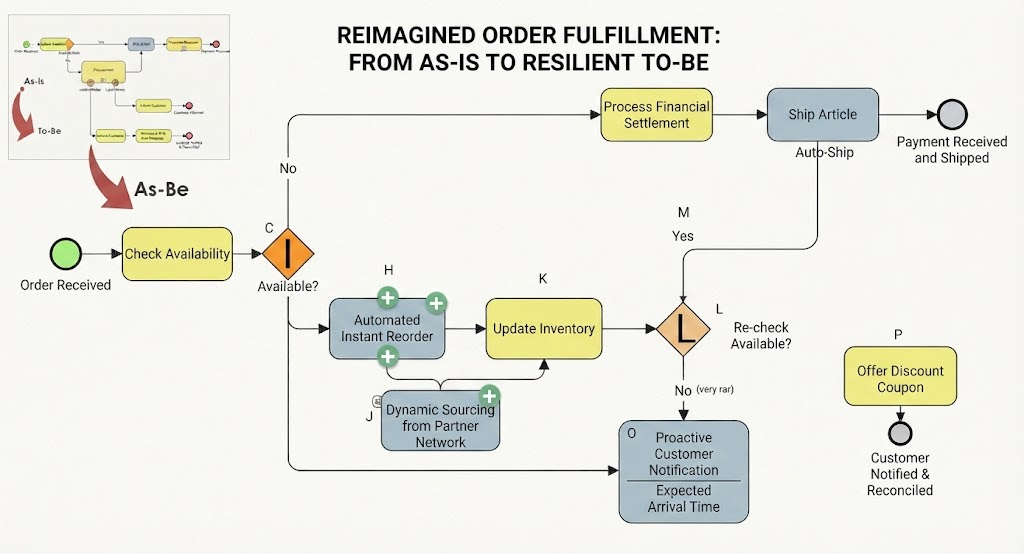
Practical Example: Inventory System Transformation
To illustrate these concepts, let’s look at a common business scenario: managing customer orders and inventory.
As-Is Process (Current State)
-
Customer Order Receipt: Sales representative receives a purchase order through the online platform.
-
Stock Checking: Manual review of inventory records (spreadsheets or legacy system) to check stock levels.
-
Inventory Assessment: Inform customer if stock is insufficient and suggest amendments.
-
Packing: Pack items if stock is available.
-
Shipping and Invoicing: Ship packed items and generate invoices manually.
As-Is BPMN Diagram:
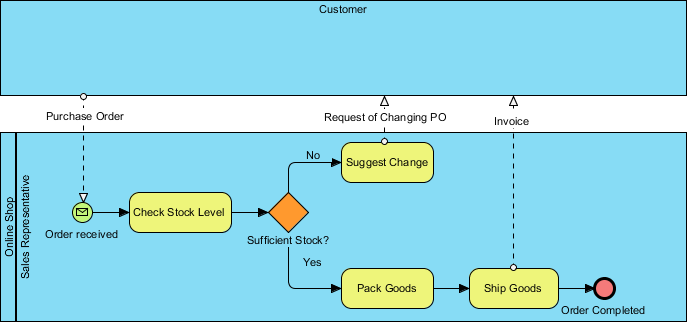
Pain Points: Manual stock checking leads to delays, human error, and frustrated sales representatives who spend time on administrative tasks rather than customer engagement.
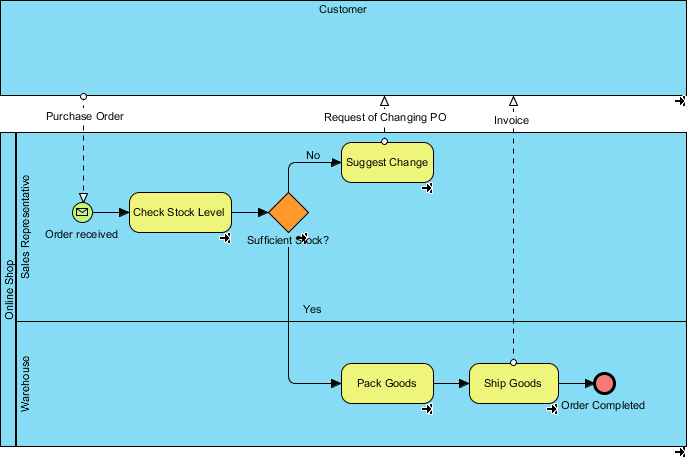
To-Be Process (Future State)
-
Customer Order Receipt: Remains the same; order enters the system via the online platform.
-
Inventory Management: An automated system checks stock levels in real-time upon order receipt.
-
Warehouse Allocation: The system automatically checks stock availability and prompts the warehouse for packing or triggers an order amendment notification if stock is low.
-
Packing and Shipping: Streamlined packing process based on accurate, real-time warehouse stock data.
-
Invoicing: Automated invoice generation upon shipment confirmation.
To-Be BPMN Diagram:
Benefits of the To-Be Process
-
Efficiency: Automation reduces delays caused by manual stock checking and data entry.
-
Resource Relief: Sales representatives are freed from administrative tasks and can focus on high-value customer interactions.
-
Inventory Accuracy: Real-time data provides better control and accuracy in inventory management, reducing overstock and stockouts.
-
Customer Satisfaction: Faster order processing and accurate stock information lead to improved customer satisfaction and loyalty.
Tips and Tricks for Successful Gap Analysis Using BPMN Approach
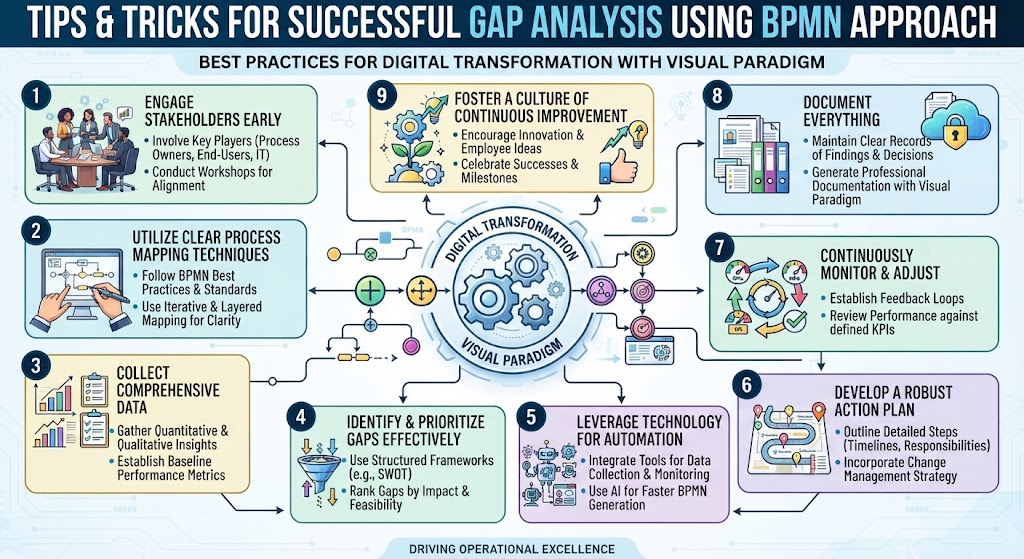
When embarking on a Gap Analysis using BPMN (Business Process Model and Notation) in the context of digital transformation, consider the following tips and tricks to enhance your process and outcomes. Leveraging tools like Visual Paradigm can significantly streamline this effort.
1. Engage Stakeholders Early
-
Involve Key Players: Ensure that all relevant stakeholders, including process owners, end-users, and IT staff, are involved from the outset. Their insights and buy-in are vital for accurately mapping the As-Is process and envisioning a realistic To-Be state.
-
Conduct Workshops: Organize collaborative workshops using Visual Paradigm’s sharing features to gather input and foster team alignment on goals and expectations.
2. Utilize Clear Process Mapping Techniques
-
BPMN Best Practices: Familiarize yourself with BPMN symbols and conventions to create clear and standardized diagrams. Visual Paradigm enforces these standards, enhancing communication and understanding among team members.
-
Iterative Mapping: Start with high-level process maps and progressively add detail. This approach helps to maintain focus and clarity without overwhelming stakeholders. Use Visual Paradigm’s layering features to manage complexity.
3. Collect Comprehensive Data
-
Quantitative and Qualitative: Gather both quantitative data (e.g., cycle times, error rates) and qualitative insights (e.g., employee feedback) to gain a holistic view of current processes.
-
Performance Metrics: Establish baseline performance metrics to compare against future improvements during the Gap Analysis. Visual Paradigm allows you to annotate diagrams with data points for easy reference.
4. Identify and Prioritize Gaps Effectively
-
Use a Structured Framework: Apply a systematic framework for identifying gaps, such as SWOT (Strengths, Weaknesses, Opportunities, Threats) analysis, to ensure a comprehensive assessment.
-
Prioritize Based on Impact: Rank identified gaps by their potential impact on the organization and the feasibility of closing them. Focus on high-impact, low-effort areas first to build momentum.
5. Leverage Technology for Automation
-
Integrate Tools: Consider integrating technology solutions that can automate data collection and process monitoring. Visual Paradigm’s AI capabilities can help generate initial drafts of BPMN diagrams from text descriptions, speeding up the modeling process.
-
Real-Time Monitoring: Implement systems that allow for real-time tracking of processes, helping to quickly identify issues and streamline operations.
6. Develop a Robust Action Plan
-
Detailed Steps: Outline clear, actionable steps for addressing each identified gap, including timelines, resources, and responsible parties.
-
Change Management Strategy: Incorporate a change management plan to facilitate the transition from the As-Is to the To-Be state. Address potential resistance and ensure adequate training and support. Visual Paradigm can help visualize the transition plan alongside the process maps.
7. Continuously Monitor and Adjust
-
Feedback Loops: Establish mechanisms for continuous feedback during and after implementation. This will help in identifying new gaps and areas for improvement.
-
Performance Reviews: Regularly review performance metrics against the defined KPIs to assess the effectiveness of changes and make necessary adjustments.
8. Document Everything
-
Maintain Clear Records: Document all findings, decisions, and changes throughout the analysis process. This will serve as a valuable resource for future reference and audits.
-
Visual Documentation: Use BPMN diagrams not only for current and future processes but also to illustrate gaps and action plans visually. Visual Paradigm’s reporting features can generate professional documentation directly from your models.
9. Foster a Culture of Continuous Improvement
-
Encourage Innovation: Promote an organizational culture that values continuous improvement and innovation. Encourage employees to share ideas for process enhancements.
-
Celebrate Successes: Acknowledge and celebrate milestones achieved during the transformation process to maintain momentum and enthusiasm.
By following these tips and tricks, organizations can effectively navigate the complexities of Gap Analysis using BPMN. This structured approach, supported by robust tooling like Visual Paradigm, will help bridge the divide between current and desired states, driving successful digital transformation and operational excellence. Embrace the journey, leverage insights, and remain adaptable to thrive in a dynamic business environment.
Conclusion
The journey from the current state to a future state of excellence begins with understanding where you are, where you want to be, and how to get there. The interrelated As-Is, To-Be, and Gap analyses provide a structured approach to evaluate operations and design efficient future states.
-
As-Is Analysis: Captures the present state with precision, highlighting inefficiencies and pain points.
-
To-Be Analysis: Envisions a better future through innovation, automation, and streamlined workflows.
-
Gap Analysis: Bridges the present and future by transforming insights into actionable steps, prioritized for maximum impact.
These analyses are not just methodologies; they embody a philosophy of growth and adaptability. As organizations embrace digital transformation, they will find that continuous improvement leads to operational excellence and lasting success. By leveraging the power of these analyses and tools like Visual Paradigm, businesses can shape their future, enhancing customer experiences and driving innovation.
Recommended Resources: Visual Paradigm Tooling
Below is a list of relevant articles and resources to help you master BPMN and leverage Visual Paradigm’s AI and modeling capabilities:
- AI BPMN Diagram Generator: Professional BPD Tool: Explains how to generate BPMN diagrams from text using AI in the Visual Paradigm desktop application.
- Comprehensive Guide to BPMN, Visual Paradigm Tooling, AI, and Ecosystem: Covers BPMN fundamentals and the ecosystem, with practical AI-generated BPMN examples like employee onboarding.
- How to Create BPMN Business Process Diagrams in Visual Paradigm: A step-by-step tutorial on drawing BPMN diagrams manually, including creating pools, lanes, tasks, gateways, and using simulation features.
- BPMN Tutorial: Visual Paradigm Tooling, AI Chatbot & Ecosystem: Details the AI Chatbot capabilities for generating and refining diagrams via conversational commands.
- AI Business Process Diagram Generator Update: Highlights the AI BPMN generator’s ability to produce complex, multi-pool diagrams from simple text prompts.
- Mastering Business Process Modeling: A Complete Guide to BPMN and AI: A comprehensive guide on BPMN basics and using the AI generator to create diagrams from natural language descriptions.
- Creating Your First BPMN Diagram in Visual Paradigm: A beginner-friendly tutorial covering essential BPMN concepts like events, gateways, and swimlanes, with practical tips.
- BPMN 2.0 Business Process Modeling Beginner’s Guide: Offers a step-by-step guide for beginners, including AI prompt strategies for effective BPMN generation.
- How to Draw BPMN Diagram?: A visual tutorial on using Visual Paradigm’s resource catalog to efficiently draw BPMN diagrams and add gateways and events.
- Mastering BPMN: A Comprehensive Tutorial with Visual Paradigm, AI Chatbot, and Ecosystem: Discusses how the AI chatbot enables rapid, iterative BPMN modeling through plain language commands.