


Introduction
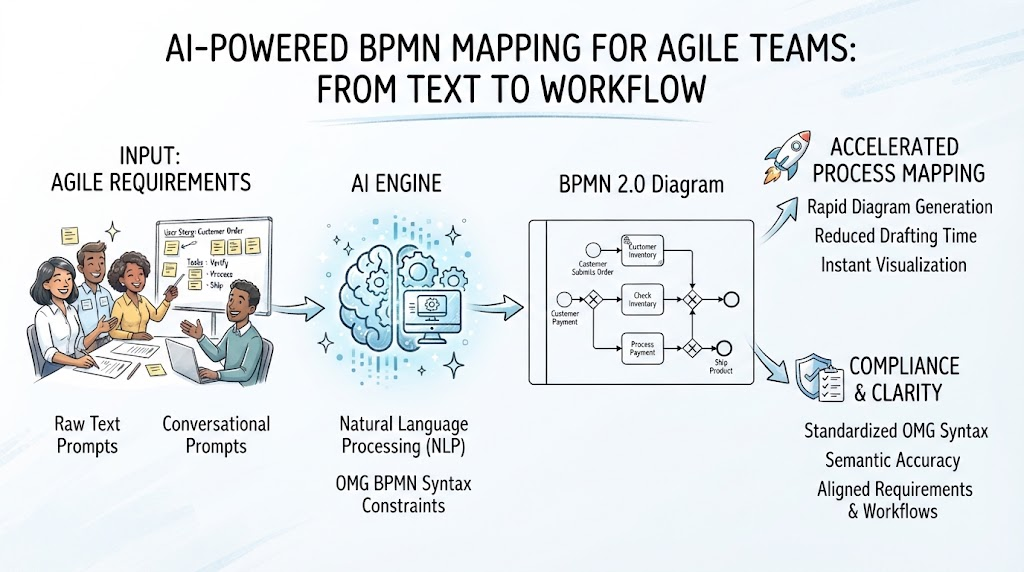
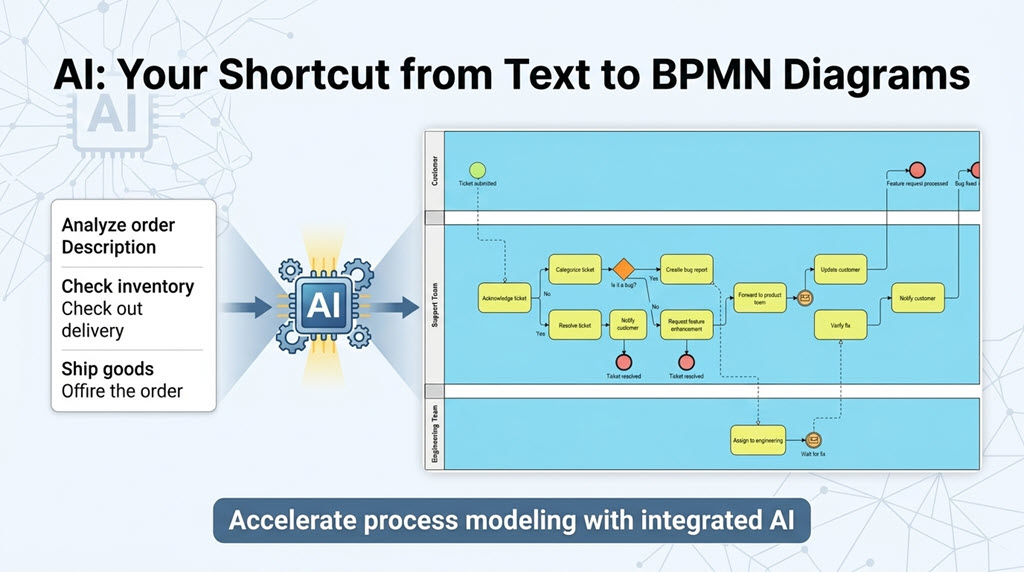
Business Process Model and Notation (BPMN) 2.0 is the global standard for visualizing business processes. For Agile teams, it serves as a critical bridge between abstract requirements and executable workflows. While traditional modeling tools often require tedious manual drafting, modern AI-integrated platforms like Visual Paradigm have revolutionized this space. By leveraging Natural Language Processing (NLP) and strict Object Management Group (OMG) syntax constraints, these tools allow teams to generate mathematically and semantically correct diagrams from raw text or conversational prompts. This guide explores how Agile teams can leverage these capabilities to accelerate process mapping, ensure compliance, and maintain clarity in complex project environments.
Why Visual Paradigm? Key Advantages for Agile Teams
Visual Paradigm stands out by embedding advanced AI engines directly into its modeling ecosystem. Unlike generic Large Language Model (LLM) tools that may produce visually appealing but syntactically flawed flowcharts, Visual Paradigm ensures strict adherence to BPMN 2.0 standards.
Core Benefits
-
Standards Compliance: The tool enforces precise OMG metamodel rules, actively blocking illegal notation such as connecting a message event directly to a gateway without an intermediate task.
-
Iterative Refinement: The AI retains full state context across long conversations. If you need to add an exception or update a step, the tool adjusts the existing diagram rather than rewriting it from scratch, preserving your previous layout decisions.
-
Native Integration: Outputs are not static images or text formats like Mermaid; they are fully editable, model-based diagrams that integrate natively into production workspaces for further manual refinement.
Usage Cases for Agile Teams
Agile methodologies thrive on adaptability and clear communication. Here is how BPMN 2.0, powered by AI tooling, supports specific Agile practices:
1. Rapid Sprint Planning and Workflow Visualization
During sprint planning, teams often discuss user stories that involve multiple handoffs. Instead of spending hours drawing boxes and arrows, team members can paste their narrative discussion into the AI generator.
-
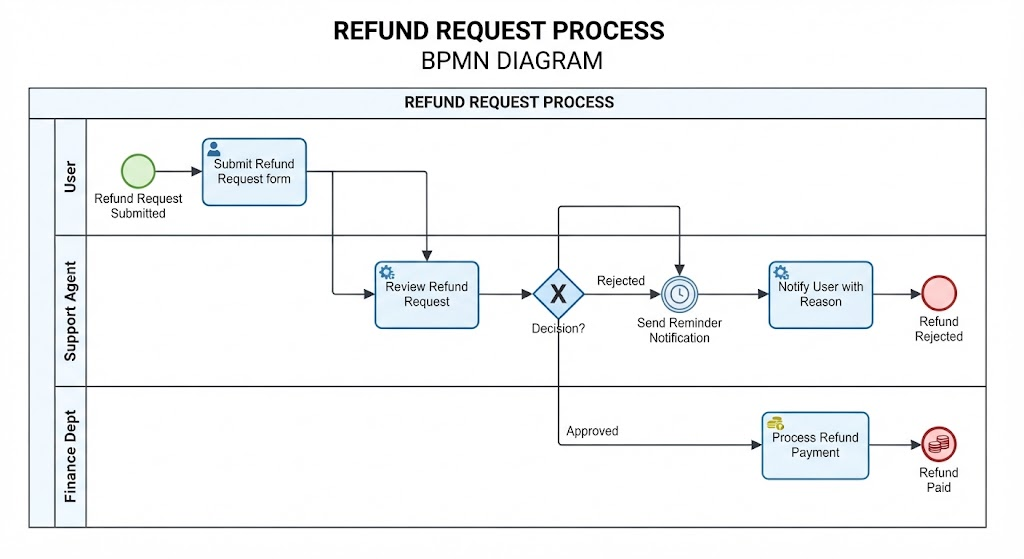
Example: “When a user submits a refund request, the support agent reviews it. If approved, finance processes the payment. If rejected, the user is notified with a reason.”
-
Outcome: The AI instantly isolates roles (Support Agent, Finance), sequential tasks, and routing logic (Approved/Rejected gateways), creating a draft swimlane diagram ready for review.
2. Clarifying Cross-Functional Dependencies
Agile teams often struggle with silos. BPMN’s swimlane feature automatically assigns tasks to specific structural pools and lanes by evaluating organizational keywords in the text.
-
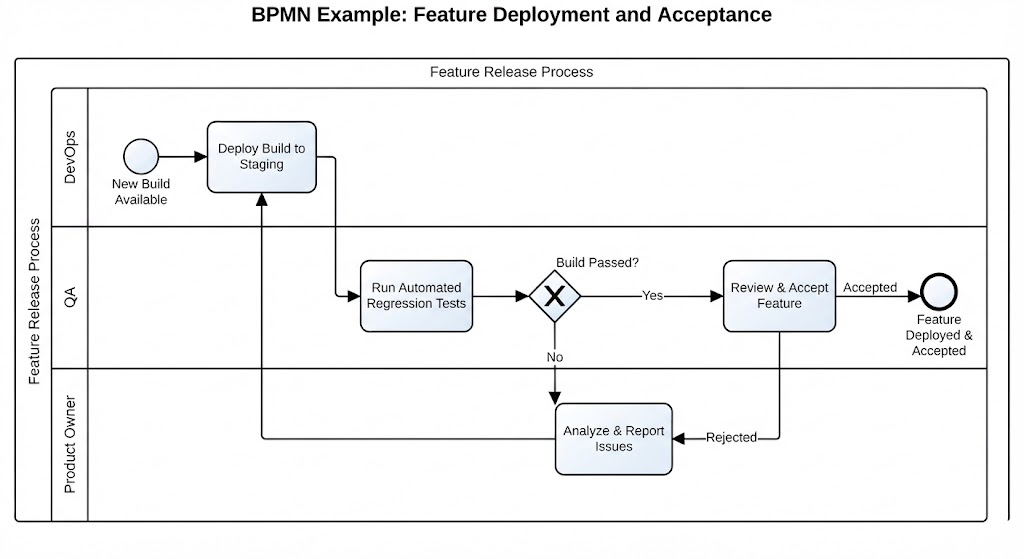
Example: A story involving “DevOps deploys the build,” “QA runs regression tests,” and “Product Owner accepts the feature.”
-
Outcome: The tool maps these actions into distinct lanes, visually highlighting handoff points and potential bottlenecks between departments.
3. Iterative Process Improvement (Retrospectives)
In retrospectives, teams identify process inefficiencies. Using the Conversational AI Chatbot, teams can iteratively prompt adjustments to reflect new realities.
-
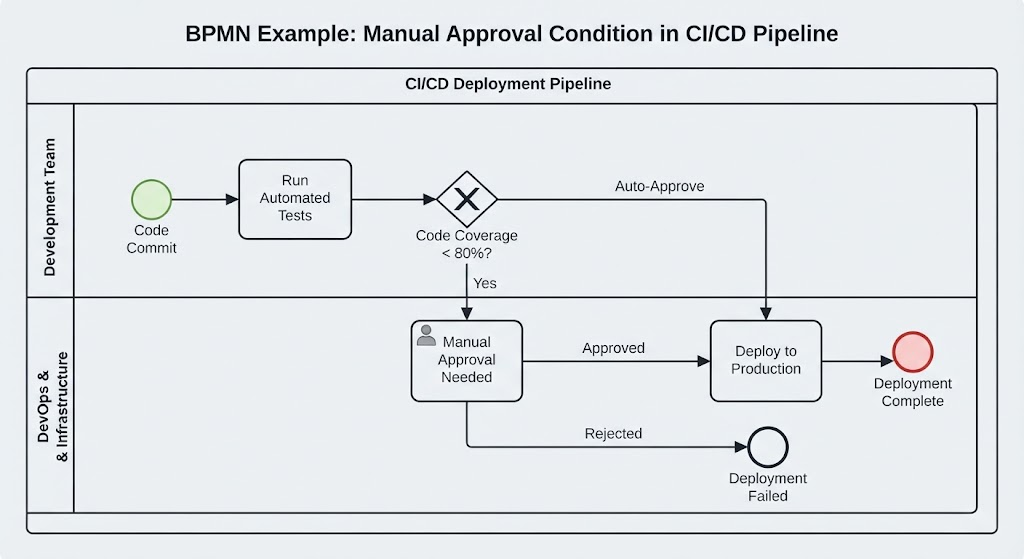
Example: “Add a manual approval step before deployment if the code coverage is below 80%.”
-
Outcome: The AI updates the existing model, adding the conditional gateway and task without disrupting the rest of the flow, allowing the team to visualize the impact of proposed changes immediately.
How to Use the AI BPMN Generator in Visual Paradigm
You can run generation directly inside the desktop suite or via the web platform using the following steps:
-
Access the Tool: Open Tools from the main menu and select AI Diagram Generation (or open the AI Chatbot panel).
-
Select Diagram Type: Choose Business Process Diagram as your targeted diagram type.
-
Configure Structure: Check the Include Pools and Lanes option to automatically segment organizational roles.
-
Input Narrative: Paste your plain-text workflow narrative into the description field. Be descriptive about roles, actions, and decision points.
-
Generate: Click OK to render the fully editable, model-based diagram.
Example: Generating a User Onboarding Process
Input Text:
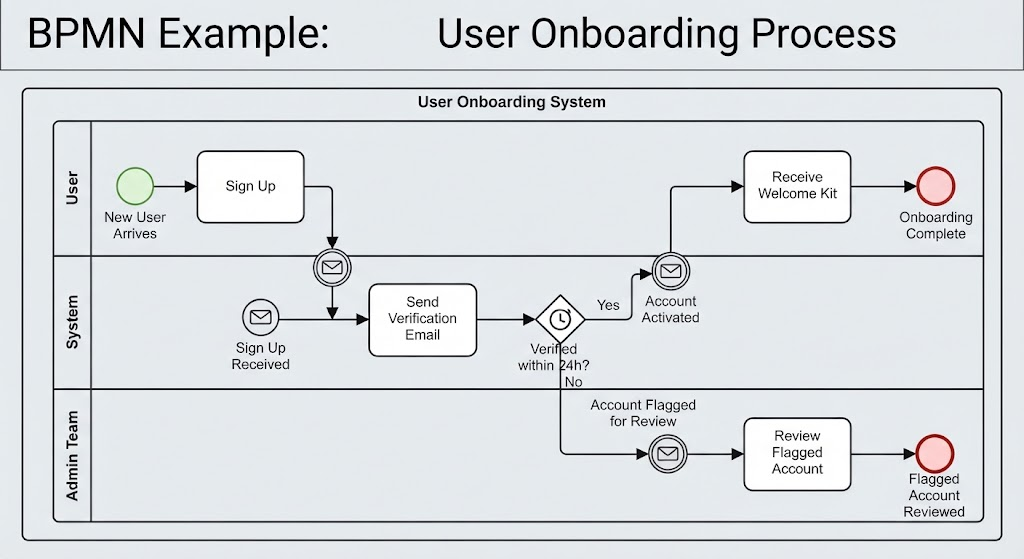
“A new user signs up on the website. The system sends a verification email. If the user clicks the link within 24 hours, their account is activated. If not, the account is flagged for review by the admin team. Once activated, the user receives a welcome kit.”
AI Output Structure:
-
Pool: User Onboarding System
-
Lane 1: User -> Task: Sign Up -> Task: Click Verification Link
-
Lane 2: System -> Task: Send Verification Email -> Gateway: Time-based Exclusive Gateway (24h)
-
Lane 3: Admin Team -> Task: Review Flagged Account
-
Flow: Correct sequence flows connecting tasks, with proper error/end events for activation or flagging.
Conclusion
BPMN 2.0 is more than just a diagramming standard; it is a language for operational clarity. For Agile teams, the integration of AI tools like Visual Paradigm removes the friction of manual modeling, allowing professionals to focus on process logic rather than drawing mechanics. By ensuring syntax compliance and enabling rapid, iterative updates, these tools empower teams to maintain living documentation that evolves alongside their products. Whether you are mapping a simple user story or a complex cross-departmental workflow, AI-driven BPMN generation offers a faster, more accurate path to process excellence.
Suggested Article Title
From Narrative to Notation: Accelerating Agile Process Modeling with AI-Driven BPMN 2.0
Recommended Reading: Visual Paradigm Resources
- From Narrative to Diagram: How Visual Paradigm’s AI BPMN Generator Transforms Process Modeling Workflows: Overview of how AI converts text descriptions into compliant BPMN diagrams.
- AI BPMN Tool Features: Detailed breakdown of core AI features including text-to-BPMN and conversational modeling.
- BPMN with Visual Paradigm AI: A Comprehensive Guide: Step-by-step tutorial on using AI for business process modeling.
- The Comprehensive Guide to BPMN Concepts, Best Practices, and Modern Tooling: Deep dive into BPMN standards and how modern tools enforce them.
- How AI-Powered NLP is Revolutionizing Text-to-BPMN Generation for Enterprise Process Modeling: Technical insight into the NLP engine behind the generator.
- AI Chatbot: A Comprehensive Guide to Visual Modeling: Guide on using the conversational interface for iterative diagram refinement.
- BPMN Tutorial: Visual Paradigm Tooling & AI Chatbot Ecosystem: Practical examples of integrating AI chatbots into BPMN workflows.
- AI BPMN Business Process Diagram Generator Update: Release notes detailing recent improvements in automated layout and matrix routing.