


Introduction
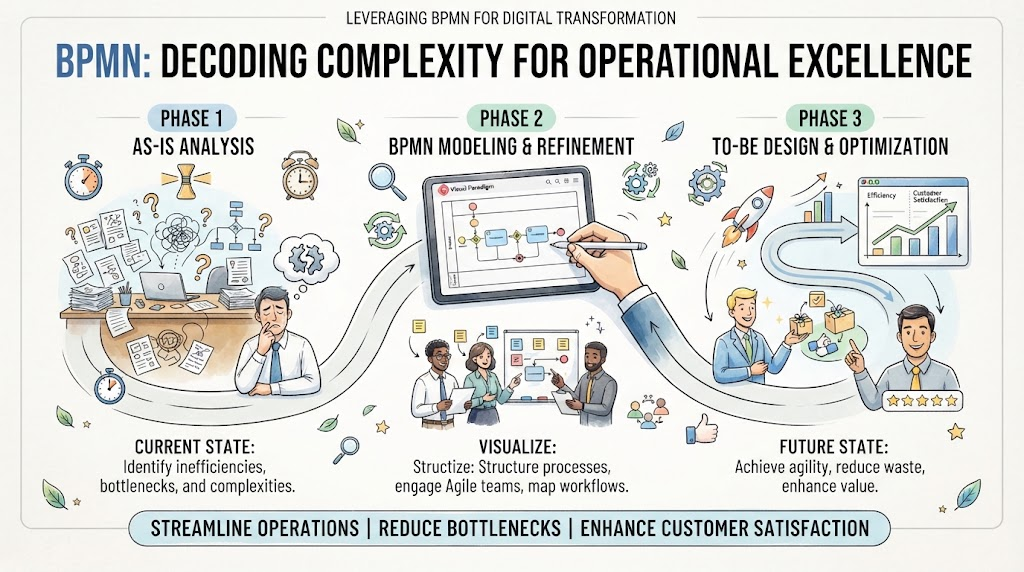
In an era where agility and efficiency define market leadership, organizations are increasingly turning to Business Process Model and Notation (BPMN) to decode complexity and drive operational excellence. While theoretical frameworks provide the foundation, real-world application reveals the true power of process modeling. This guide explores how companies across various industries leverage BPMN to streamline operations, reduce bottlenecks, and enhance customer satisfaction.
By examining practical use cases—particularly within Agile teams—and highlighting the role of advanced tooling like Visual Paradigm, we demonstrate how structured process visualization transforms abstract strategies into actionable, measurable improvements. Whether you are managing a software development sprint or optimizing a global supply chain, understanding the interplay between As-Is analysis, To-Be design, and Gap analysis is essential for successful digital transformation.
The Strategic Value of BPMN in Modern Business
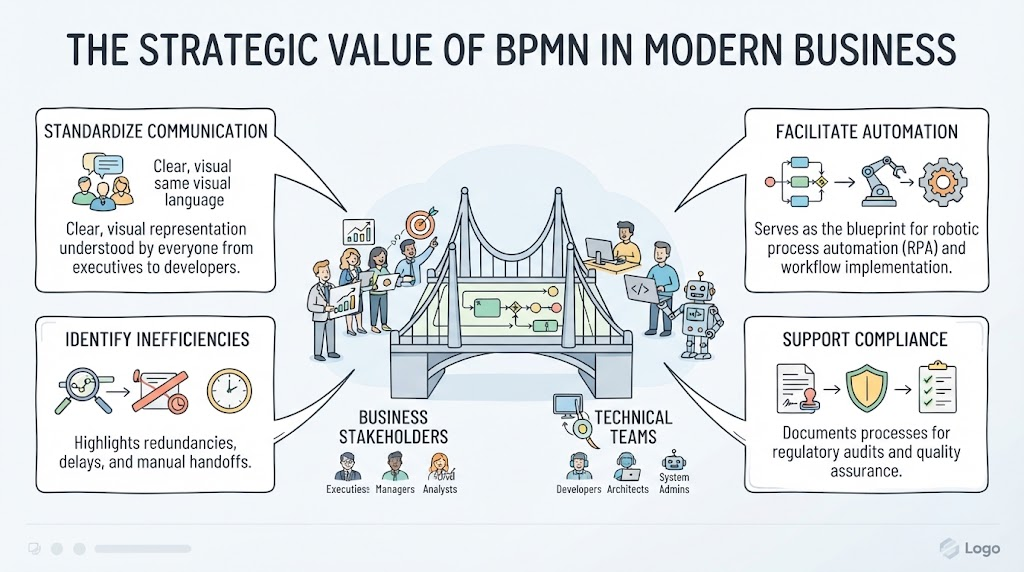
BPMN is more than just a diagramming standard; it is a universal language that bridges the gap between business stakeholders and technical teams. Its primary value lies in its ability to:
-
Standardize Communication: Provide a clear, visual representation of processes that everyone from executives to developers can understand.
-
Identify Inefficiencies: Highlight redundancies, delays, and manual handoffs that hinder performance.
-
Facilitate Automation: Serve as the blueprint for robotic process automation (RPA) and workflow engine implementation.
-
Support Compliance: Document processes for regulatory audits and quality assurance standards.
Real-World Case Studies: Streamlining Operations
Case Study 1: Financial Services – Accelerating Loan Approval Processes
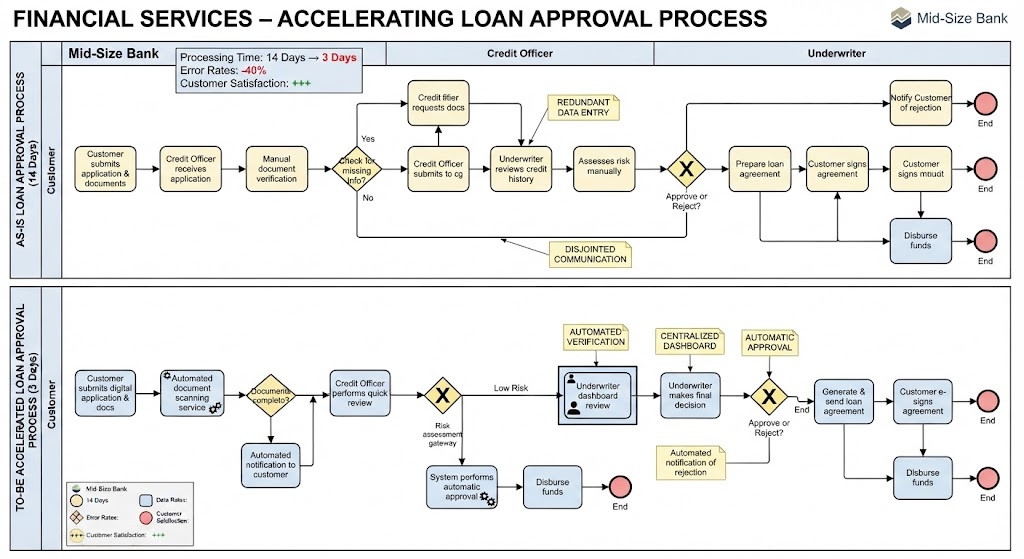
Challenge: A mid-sized bank faced significant delays in loan approvals due to manual document verification and disjointed communication between credit officers and underwriters. The average processing time was 14 days, leading to customer churn.
BPMN Solution:
-
As-Is Analysis: The team mapped the existing workflow, revealing multiple manual handoffs and redundant data entry points.
-
To-Be Design: They redesigned the process using BPMN to integrate an automated document scanning system and a centralized dashboard for underwriters. Gateways were added to route low-risk applications for automatic approval.
-
Outcome: Processing time dropped to 3 days, error rates decreased by 40%, and customer satisfaction scores improved significantly.
Case Study 2: Healthcare – Optimizing Patient Onboarding
Challenge: A hospital network struggled with inconsistent patient onboarding experiences across different departments, resulting in delayed treatments and administrative errors.
BPMN Solution:
-
As-Is Analysis: Stakeholder interviews and process mapping identified varying procedures for insurance verification and medical history collection.
-
To-Be Design: A standardized BPMN diagram was created to unify the onboarding process. Digital forms replaced paper records, and automated alerts were implemented for missing information.
-
Outcome: Administrative workload reduced by 30%, patient wait times decreased, and data accuracy improved, enabling better clinical decision-making.
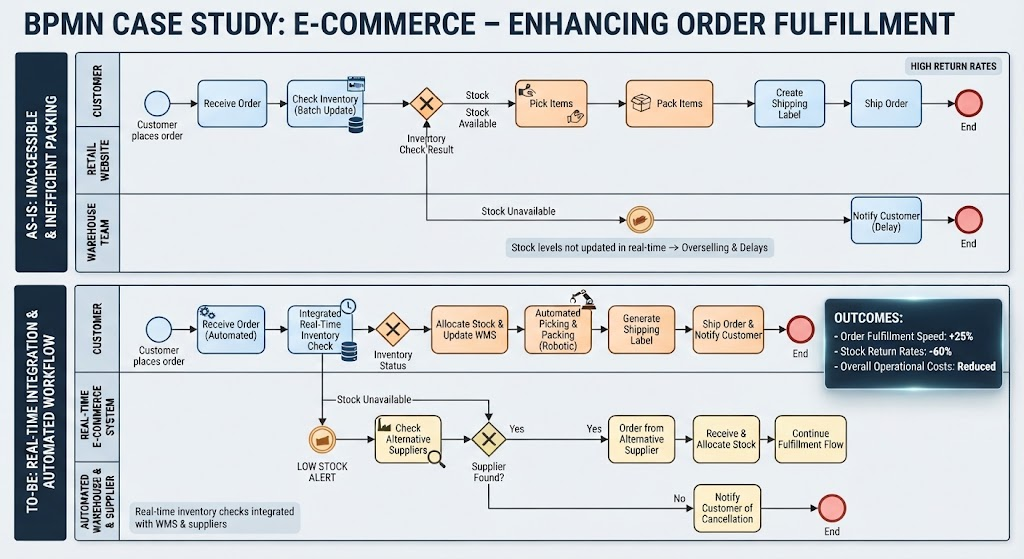
Case Study 3: E-Commerce – Enhancing Order Fulfillment
Challenge: An online retailer experienced high return rates and shipping delays during peak seasons due to inventory mismatches and inefficient packing workflows.
BPMN Solution:
-
As-Is Analysis: The team discovered that stock levels were not updated in real-time, leading to overselling.
-
To-Be Design: They implemented a BPMN-driven workflow that integrated real-time inventory checks with warehouse management systems. Automated triggers were set for low-stock alerts and alternative supplier notifications.
-
Outcome: Order fulfillment speed increased by 25%, return rates due to stock issues dropped by 60%, and overall operational costs were reduced.
BPMN Use Cases for Agile Teams
Agile methodologies thrive on adaptability, but without clear process visibility, teams can struggle with scope creep and misalignment. BPMN provides the structure needed to maintain agility while ensuring consistency.
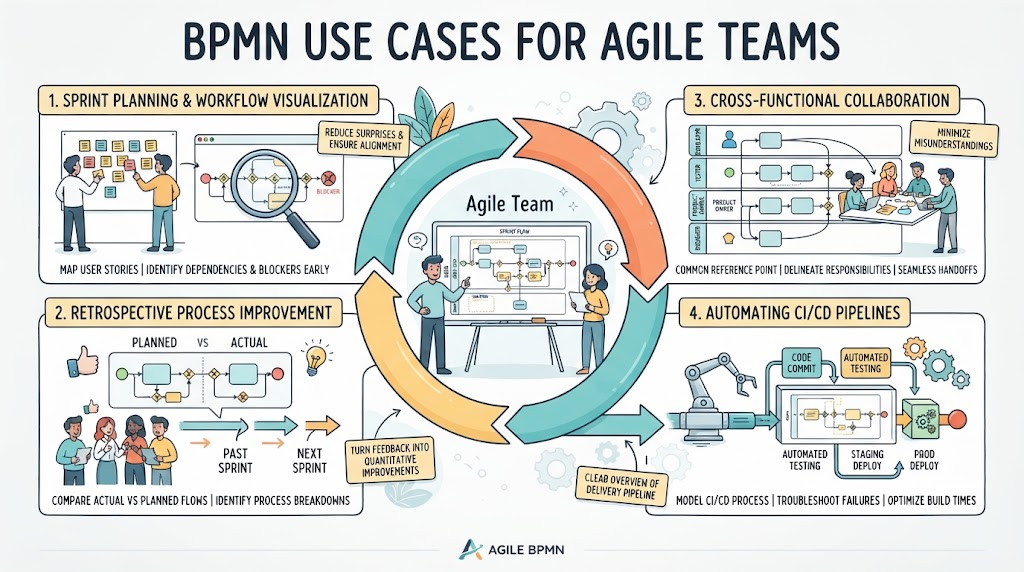
1. Sprint Planning and Workflow Visualization
Agile teams can use BPMN to map out user story workflows before development begins. This helps identify dependencies, potential blockers, and acceptance criteria early in the sprint.
-
Benefit: Reduces mid-sprint surprises and ensures all team members understand the end-to-end flow of a feature.
2. Retrospective Process Improvement
During sprint retrospectives, teams can update their BPMN diagrams to reflect actual vs. planned workflows. This visual comparison makes it easier to identify where processes broke down.
-
Benefit: Turns qualitative feedback into quantitative process improvements for the next sprint.
3. Cross-Functional Collaboration
BPMN diagrams serve as a common reference point for developers, testers, product owners, and UX designers. Swimlanes can clearly delineate responsibilities across roles.
-
Benefit: Minimizes misunderstandings and ensures that handoffs between teams are seamless.
4. Automating CI/CD Pipelines
For DevOps-oriented Agile teams, BPMN can model continuous integration and deployment pipelines. This includes steps for code commit, automated testing, staging, and production deployment.
-
Benefit: Provides a clear overview of the delivery pipeline, making it easier to troubleshoot failures and optimize build times.
Recommended Tooling: Why Visual Paradigm?
While many tools exist for creating BPMN diagrams, Visual Paradigm stands out as a comprehensive solution for organizations serious about process improvement. Here’s why it is highly recommended:
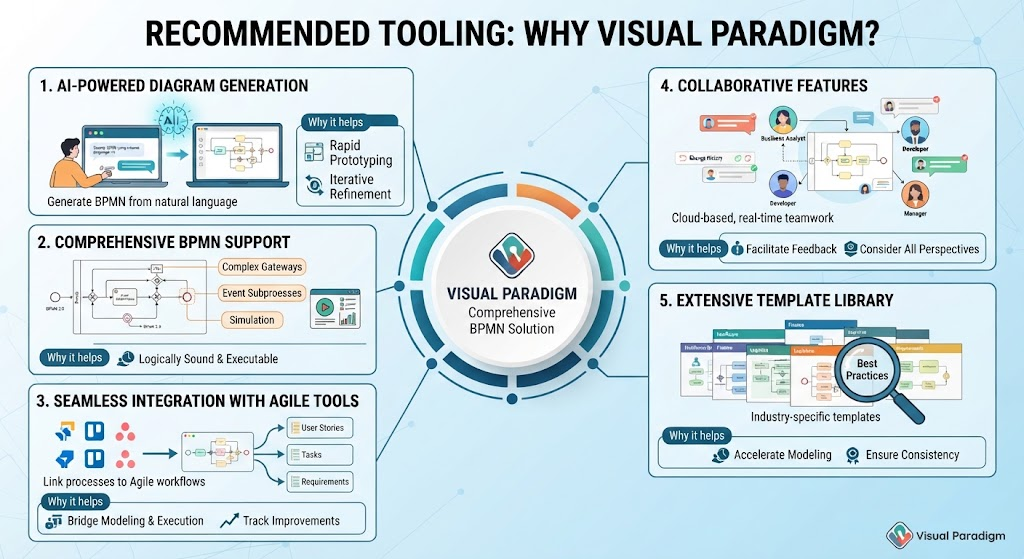
1. AI-Powered Diagram Generation
Visual Paradigm integrates AI capabilities that allow users to generate BPMN diagrams from natural language descriptions. This drastically reduces the time spent on initial modeling and lowers the barrier to entry for non-technical stakeholders.
-
Why it helps: Enables rapid prototyping of processes and encourages iterative refinement through conversational commands.
2. Comprehensive BPMN Support
The tool supports the full BPMN 2.0 specification, including complex gateways, events, and subprocesses. It also offers simulation features to test process logic before implementation.
-
Why it helps: Ensures diagrams are not just visually appealing but logically sound and executable.
3. Seamless Integration with Agile Tools
Visual Paradigm integrates with popular Agile management tools, allowing teams to link process models directly to user stories, tasks, and requirements.
-
Why it helps: Bridges the gap between process modeling and project execution, ensuring that improvements are tracked and implemented.
4. Collaborative Features
With cloud-based collaboration, multiple stakeholders can work on the same diagram simultaneously, leave comments, and track changes.
-
Why it helps: Facilitates real-time feedback and ensures that all perspectives are considered during the As-Is and To-Be analysis phases.
5. Extensive Template Library
Access to a wide range of industry-specific BPMN templates accelerates the modeling process and ensures best practices are followed.
-
Why it helps: Provides a starting point for common processes, reducing setup time and ensuring consistency across projects.
Tips for Successful BPMN Implementation
-
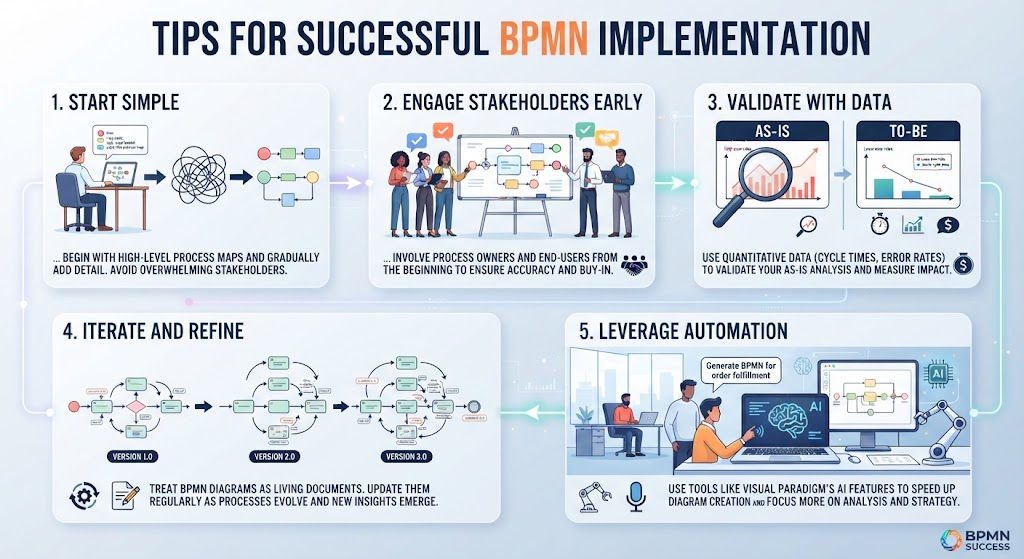
Start Simple: Begin with high-level process maps and gradually add detail. Avoid overwhelming stakeholders with overly complex diagrams initially.
-
Engage Stakeholders Early: Involve process owners and end-users from the beginning to ensure accuracy and buy-in.
-
Validate with Data: Use quantitative data (cycle times, error rates) to validate your As-Is analysis and measure the impact of your To-Be improvements.
-
Iterate and Refine: Treat BPMN diagrams as living documents. Update them regularly as processes evolve and new insights emerge.
-
Leverage Automation: Use tools like Visual Paradigm’s AI features to speed up diagram creation and focus more on analysis and strategy.
Conclusion
The journey from operational chaos to streamlined excellence begins with clarity. By leveraging BPMN, organizations can visualize their current state, envision a more efficient future, and bridge the gap with actionable plans. Real-world case studies in finance, healthcare, and e-commerce demonstrate the tangible benefits of this approach, from reduced processing times to improved customer satisfaction.
For Agile teams, BPMN offers a structured yet flexible framework to enhance collaboration, plan sprints effectively, and continuously improve workflows. With powerful tooling like Visual Paradigm, the barriers to entry are lower than ever, enabling teams to harness AI-driven insights and collaborative features for faster, more accurate process modeling.
Embrace BPMN not just as a diagramming technique, but as a strategic asset. By making processes visible, measurable, and improvable, businesses can navigate the complexities of digital transformation with confidence and achieve lasting operational excellence.
Reference Resources: Visual Paradigm Tooling
- AI BPMN Diagram Generator: Professional BPD Tool: Explains how to generate BPMN diagrams from text using AI in the Visual Paradigm desktop application.
- Comprehensive Guide to BPMN, Visual Paradigm Tooling, AI, and Ecosystem: Covers BPMN fundamentals and the ecosystem, with practical AI-generated BPMN examples like employee onboarding.
- How to Create BPMN Business Process Diagrams in Visual Paradigm: A step-by-step tutorial on drawing BPMN diagrams manually, including creating pools, lanes, tasks, gateways, and using simulation features.
- BPMN Tutorial: Visual Paradigm Tooling, AI Chatbot & Ecosystem: Details the AI Chatbot capabilities for generating and refining diagrams via conversational commands.
- AI Business Process Diagram Generator Update: Highlights the AI BPMN generator’s ability to produce complex, multi-pool diagrams from simple text prompts.
- Mastering Business Process Modeling: A Complete Guide to BPMN and AI: A comprehensive guide on BPMN basics and using the AI generator to create diagrams from natural language descriptions.
- Creating Your First BPMN Diagram in Visual Paradigm: A beginner-friendly tutorial covering essential BPMN concepts like events, gateways, and swimlanes, with practical tips.
- BPMN 2.0 Business Process Modeling Beginner’s Guide: Offers a step-by-step guide for beginners, including AI prompt strategies for effective BPMN generation.
- How to Draw BPMN Diagram?: A visual tutorial on using Visual Paradigm’s resource catalog to efficiently draw BPMN diagrams and add gateways and events.
- Mastering BPMN: A Comprehensive Tutorial with Visual Paradigm, AI Chatbot, and Ecosystem: Discusses how the AI chatbot enables rapid, iterative BPMN modeling through plain language commands.